


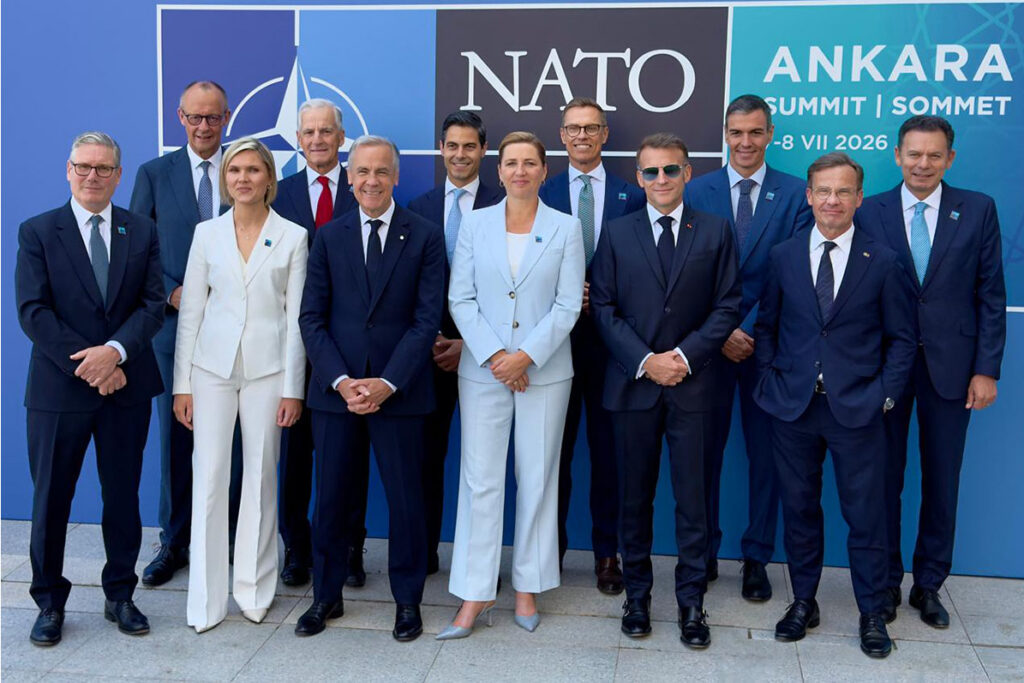
What happened in Ankara? It will take us some time to know its effects. to see the effects. But the NATO Summit, with Erdogan as a cunning host, demonstrated something important: NATO is not in “brain death” – that kind of useless inertia that French President Emmanuel Macron warned about in an interview with The Economist in November 2019.
Rather, NATO is in full crisis and at the center of the debate: with doubts, fractures, steps forward and backward. The problem with the organization is that, unlike in the past, its true “Commander in Chief” —the President of the U.S., Donald Trump— is not interested in the European Union (rather he prefers to divide or subjugate it). He does not believe in the utility of an Alliance that does not strictly adhere to the “national interest” understood in a selfish way. The fiasco of the war against Iran and the Strait of Hormuz is the most recent proof. At its core, NATO’s doctrine is worthless in the face of the America First of the new National Security Strategy, for which it is clear that NATO is merely an instrument in service of U.S. hegemony. This must be made clear for the coming years.
Now, despite Trump’s pantomime, the threats (Greenland) or the insults (insults to Meloni!, Sánchez, etc.), the organization functions, albeit with strong jolts and an uncertain horizon. The Final Declaration has secured a commitment to the collective defense of Article 5 of the Charter, and promises such as 70 billion euros in aid to Ukraine from Europe and Canada. Europe has “saved face” with its budget increase effort for 2026 above 2% or even above 3.5% (Poland, Germany). Also, Sánchez’s Spain, very pedagogical about our commitment as a good ally, came out very much alive from the Summit.
The U.S. will continue in the organization because NATO has been since 1949 and will continue to be a great business for the U.S. Strategic business: for its projection in the Middle East, Africa, Eastern Europe, or Central Asia. Economic business: for its military-industrial complex, which has seen arms sales to Europeans multiply to support Ukraine; or deliveries of F35s (to Turkey), satellites, air defense/Patriots; licenses for production on European soil (the German Merz has also offered); and a long etcetera. Hence the Defense Industry Forum parallel to the summit, accompanied by the top brass: secretaries Marco Rubio or Pete Hegseth, among others. Before the Summit, there was a dance of figures to show off. The ever-helpful Secretary General Mark Rutte spoke of 300 billion dollars accumulated in purchases of material from the U.S. in recent years. Mathew Whittaker, U.S. ambassador to NATO, estimated that half of 120 billion dollars corresponded to European acquisitions of material from American companies.
But beyond the business, it must be taken into account that Trump is not eternal; in a few years, another less confrontational Administration with the EU and the Alliance partners could arrive. The U.S. will not leave: we can expect a “tremendous unity” amid the chaos, as Trump announced at the end of the meeting in Ankara.
Therefore, we should focus more on another more concerning issue, beyond NATO: that Europe is still not. It is not ready to defend itself alone if things go very wrong. And it also has not yet found the way to unite around concrete programs of technological sovereignty and its own security. We are pondering how to advance in European independence and reduce vulnerabilities. The next two decades will consist of this, and knowing what will happen with Ukraine (which could become a powder keg if not handled carefully), and of course, with Russia (if we are going to reintegrate it into the Euro-Asian family).
However, there is room for some optimism. Announcements about new European capabilities, such as the Airbus A400M strategic transport aircraft, or the investment of 50 billion dollars in drones and new “smart” weapons; 30 billion dollars in oil and gas connection in the East corridor; prior declarations of technological sovereignty from France and Germany; the announcements from the Von der Leyen Commission about financing (SAFE loans; EIB; eurobonds): all of this indicates that Europe is moving in survival impulses, after the recent fiasco of the European combat aircraft FACAS.
In a way, the U.S. has reasons to experience a certain existential crisis about its security or its allies. Many things have changed after the Cold War: the main one is China. And the U.S. faces dramatic dilemmas. Likewise, Europe: it has to rationalize its “Rearmament”, give it balance and meaning. To top it off, possible far-right governments are emerging in France or Germany this decade.
The conflicts in Ukraine, Gaza, or Iran show that the nature of war is changing. Due to drones, AI, disinformation, and new military strategies focused on resilience. Winning a war is as difficult as addressing the subsequent material and political reconstruction. Everything is as difficult as managing a 20th-century organization, overwhelmed by the events of the 21st century.