This year marks the 250th Anniversary of the Declaration of Independence of the United States, which, according to the prestigious American historian Larie Ferreiro, was directed more at the rival European powers, France and Spain, than at the Government of England, as an essential requirement for the rebellious colonies to request support from those sovereign states.
Immediately after independence was proclaimed, Congress sent a delegation to Europe made up of Benjamin Franklin, Arthur Lee, and Silas Dean, which arrived in late 1776 in Paris, where they were received by the French Minister of Foreign Affairs, Count Vergennes, who put them in contact with the Spanish ambassador to the court of Louis XVI.
The assistance provided later by both France and Spain to the army of the independence leaders is well known. The value of the aid in military supplies, uniforms, and the financial assistance that the Government of Charles III secretly sent to the rebellious colonies can be assessed with great precision, allowing them to resist and defeat the enemy in the first stage of the conflict.
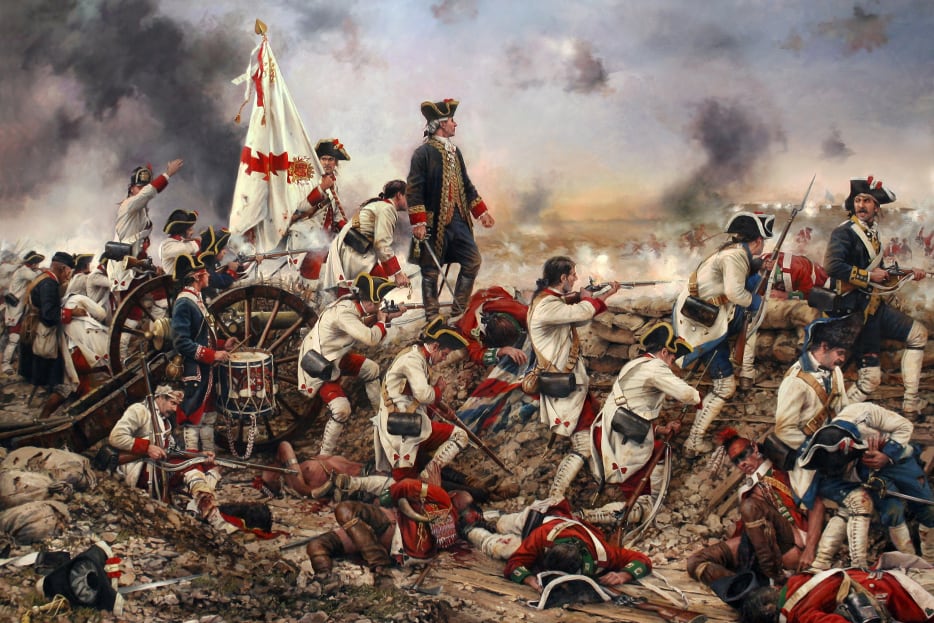
After the official declaration of war in 1779, the successful campaigns of Bernardo de Gálvez on both sides of the Mississippi and in the British strongholds of the Gulf of Mexico — culminating in 1781 with the capture of Pensacola — allowed the blocking of the English fleet’s access to the Gulf of Mexico and the strategic Bahamas Canal. This would enable George Washington’s “Continental Army” to resist English troops in the northern states and eventually win the decisive victory at Yorktown, a battle in which Spanish troops did not intervene but significant financial aid was provided by the royal commissioner Francisco de Saavedra, a close friend and companion of Gálvez, to the French admiral De Grasse.
The political and diplomatic intricacies that occurred between the governments of France, Spain, and the representatives of the new nation are less well known. To understand the difference between France’s immediate response and the Spanish Government’s assistance, which was more cautious and less direct at the beginning of the conflict, it is essential to mention the background of the Seven Years’ War, which, after the defeat of France and Spain, culminated in the Treaty of Paris in 1763.
By the Treaty of 1763, Spain was forced to cede Florida, Fort St. Augustine, and Pensacola Bay to England, in order to recover the territories occupied by the English in Cuba and the Philippines, but King Charles III was able to maintain the rest of his domains in North America, also adding the territory of Louisiana and the port of New Orleans, ceded by France as compensation for Spain’s war losses. In contrast, France had lost practically all its territories in North America so that when the rebel leaders proposed that it immediately enter the war against England, it had nothing to lose. The government of Charles III, however, had to consider the negative effects of a break with England, which is why it took longer to declare war on its ancestral enemy.
Both during the time the conflict developed and in the subsequent phase, the reasons why some independence leaders did not clearly show their gratitude for Spanish assistance have been sought, which later resulted in a lack of recognition in the public opinion of the new country.
Among the factors for the lack of greater recognition by the leaders of the United States, we can find objective reasons and others subjective that we could call psychological. Among the latter, the prejudices about Spain’s legacy in America that England had spread and that were largely adopted by the leaders of the rebellious colonies.
And also that the permanence of the Spanish presence on the banks of the Mississippi River posed an obstacle to the longed-for expansion of the new state to the west; thus, from a necessary ally to win the war against England, Spain became a rival and powerful neighbor.
In 1783, it was the Count of Aranda’s turn to negotiate the Treaty of Paris as Spain’s plenipotentiary with Benjamin Franklin; the Count of Floridablanca, who had already disavowed his ambassador on other occasions, did not consent to discuss the issue of borders or the exclusive right of navigation on the Mississippi for Spain. Thus, these important issues, unresolved in the Paris negotiations, would become the apple of discord between the two countries. Floridablanca vainly tried to remedy this omission by sending the Bilbao merchant Diego Gardoqui to negotiate with the Congress of the United States, without achieving his goals.
Another antecedent of the possible influence of Spanish doctrine on the statements of the Declaration of Independence and the Constitution of the United States, which is very little known and recognized, is found in the postulates of the School of Salamanca, which was the first to formulate a systematic and coherent doctrine of Human Rights in Modernity, to demand political and legal respect for the dignity of the uncivilized and barbaric, such as those unjustly considered Native Americans, condemning all forms of enslavement, whether de facto or de jure.
In fact, the theory of good government was based on two concepts: the popular origin of power and the cession of its management by an established pact. The School of Salamanca is credited with the first concept of popular sovereignty, in opposition to despotism, which would foster the Enlightenment; the Salamanca scholars placed power in the people. Anglo-Saxon historiography has only mentioned the reference to Locke and the Enlightenment, ignoring the School of Salamanca.
In reviewing the political, diplomatic, and ideological background of a conflict whose outcome would change the elements of the known world, it seems essential to me to mention the background of elements that do not usually appear in most essays on Spain’s assistance to the independence of the United States.