


Sustainability continues to reinforce its role as a strategic function within Ibero-American organizations. 93.8% of companies are committed to integrating corporate social responsibility (CSR) transversally, and 58% of sustainability areas already report directly to the Presidency, General Management, or the Board of Directors.
However, only 10.8% of organizations allocate more than 1% of their budget specifically to CSR actions. These are some of the conclusions drawn from the IV Sustainability Observatory in Ibero-America, prepared by EAE Business School, part of the higher education network Planeta Formación Universidades, together with the Council of Ibero-American Entrepreneurs (CEIB) and the Ibero-American Federation of Young Entrepreneurs (FIJE).
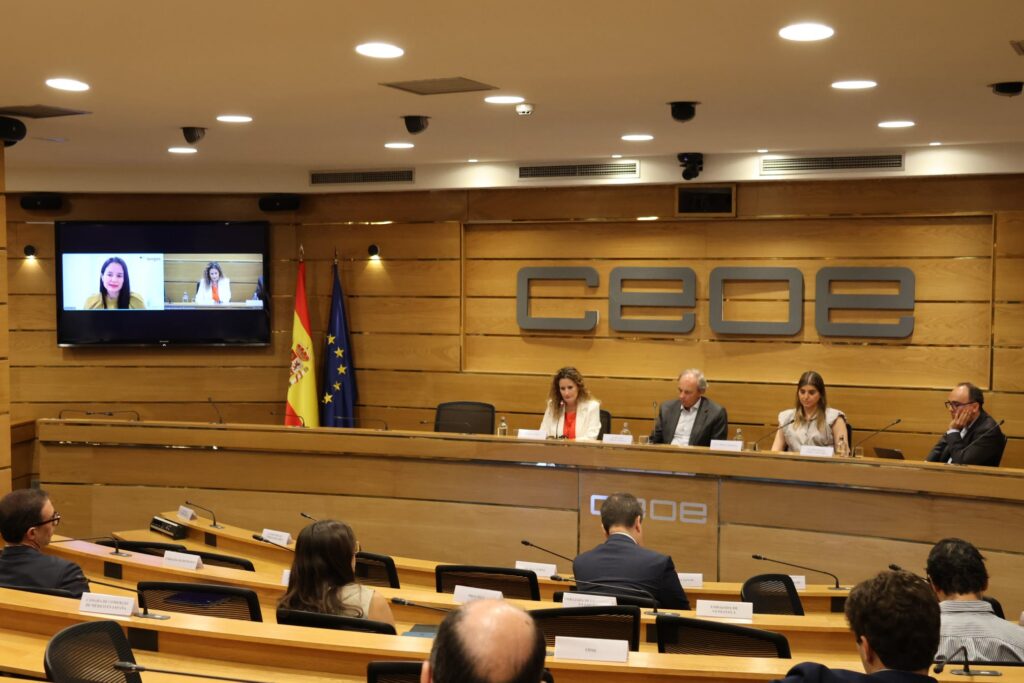
The author of the study and director of the Master’s in ESG Sustainability at EAE Business School, May López, presented this fourth edition of the report at the CEOE headquarters, during a session inaugurated by Antonio Garamendi, president of the CEOE and the Council of Ibero-American Entrepreneurs (CEIB); Tomás Aznar, dean at EAE Business School; and Matías Fernández, president of the Ibero-American Federation of Young Entrepreneurs (FIJE).
The report shows that Corporate Social Responsibility has reached a high degree of organizational maturity, with greater integration into the business structure, an increasing prominence of governance, and a more determined commitment to managing stakeholder groups.
The study, which analyzes the conceptual, regulatory, and organizational evolution of sustainability in Ibero-American companies and associations since 2020, identifies a significant transformation in the way organizations understand CSR. Far from being conceived as an isolated or voluntary initiative, sustainability becomes part of the business strategy and decision-making processes.
However, the report also highlights relevant challenges regarding resources. Only 10.8% of organizations allocate more than 1% of their budget specifically to CSR actions, while one-third still does not have a specific budget item, and 22.7% do not quantify this investment. These data reflect the journey that still exists to consolidate economic planning and the measurement of the impact of sustainability within organizations.
For the first time since the creation of the Observatory in 2020, meeting the expectations of stakeholders becomes the main strategic objective of CSR, with 63.9% of responses, surpassing the generic contribution to society.
This result reflects an evolution towards a sustainability model more oriented towards dialogue, the creation of shared value, and the management of relationships with all actors that are part of the business ecosystem.
On the other hand, governance is positioned as the main strategic priority for the coming years, with a weighted importance of 14.3%, ahead of environmental issues and customer relations. Likewise, the concept of good governance continues to gain relevance within organizations and increases by 7.3 percentage points compared to the previous edition, reaching a weight of 19.3%. This evolution is particularly significant in Europe, where it represents 38.7%, compared to 13.5% recorded in America, highlighting the effect of new regulatory demands on business management.
A new risk map
The study reveals a profound transformation in the concerns of organizations. For the first time, cybersecurity tops the perceived risks, practically tied with the economic crisis, and displaces climate change to third place. Corruption and fraud show the largest rise in the ranking (+10.2 points). In parallel, organizations change their prioritization regarding the SDGs, where energy (SDG 7) surpasses climate (SDG 13) for the first time in relevance, which suffers the largest drop in the entire report (-19.3 points), in a context marked by energy costs, geopolitics, and the vulnerability of supply chains.
Overall, the results of the IV Observatory show that sustainability has ceased to be a complementary area to become a structural element of business management in Ibero-America. The integration of CSR into strategy, the advancement of regulation, and the growing weight of governance configure a scenario in which organizations reinforce their commitment to more transparent, responsible, and long-term oriented management.