


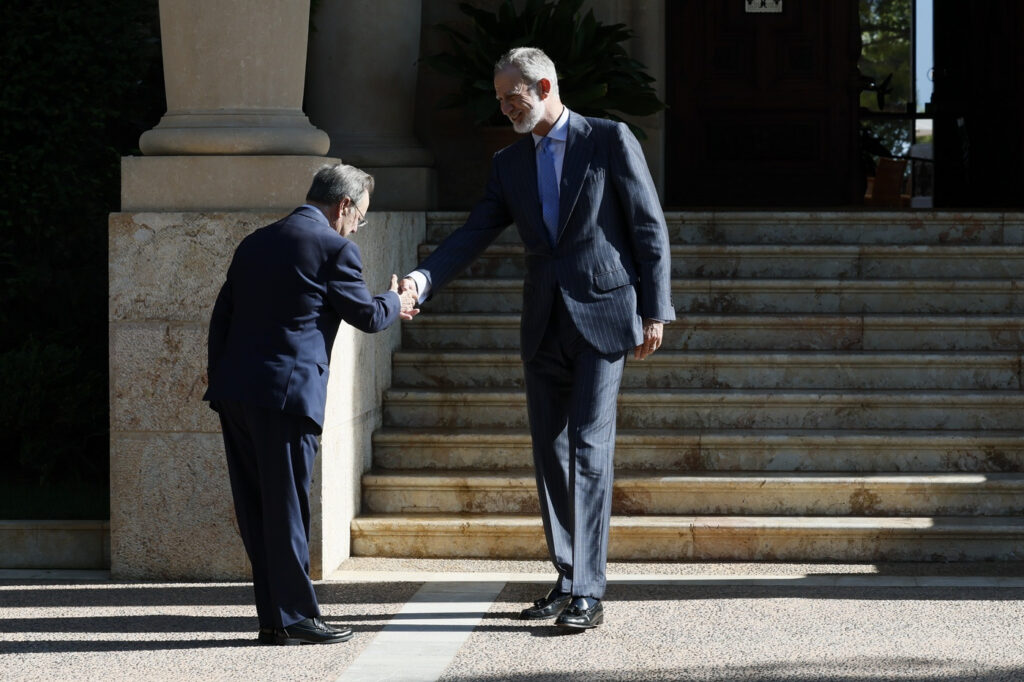
The president of the autonomous city of Ceuta said yesterday, at the end of his meeting with King Felipe VI in Marivent: “The king is committed to the visit to Ceuta and he will do it”. A visit that, while necessary, will add more diplomatic tension to the complicated Spanish-Moroccan relations and new headaches for Pedro Sánchez’s Government.
Vivas (PP) added that he does not know the date, but he was confident that the visit will take place “because the king fulfills his commitments; I cannot tell you when, but I am convinced that he will fulfill the commitment he has personally made and will go to Ceuta”.
The former director of the National Intelligence Center, Jorge Dezcallar —a diplomat with extensive experience including having been ambassador in Rabat— stated yesterday on the radio station Onda Cero that he is totally in agreement with the decision to visit Ceuta because “the people of Ceuta need to know that we are with them and the highest expression is a royal visit”.
Dezcallar also explained that this visit will require the agreement of the Government of Spain, although he considered that the fact of making the initiative public means that it is already agreed: “if the king has expressed this desire to visit Ceuta and Melilla, it must be that he has already discussed it with the president and that he has told him that it is very good”.
However, at the time of writing this information, neither the Ministry of Foreign Affairs nor the Presidency of the Government had made any comment on the matter, considering that the authorities in Rabat have always reacted, at the very least, with indignation when the possibility of a Spanish monarch visiting Ceuta or Melilla has been raised.
It happened in 2007, when Kings Juan Carlos and Sofía traveled to both North African cities and the reaction of the Rabat regime was to call its ambassador in Madrid for consultations, who remained outside Spain for two months, causing a serious diplomatic clash that took time to resolve.
Previously, the previous visit of a Spanish monarch, Alfonso XIII, took place in October 1927. At that time, northern Morocco was still a protectorate of Spain.
The president of Melilla, Juan José Imbroda, also from the PP like his Ceuta counterpart, clarified that the visit to either of the cities must be authorized by the central Government”, after assuring that he is aware of “the monarch’s willingness to visit” his city.
For its part, the Government of Ceuta interprets this audience as a “gesture that constitutes an institutional and moral support that has enormous value for the people of Ceuta in especially complex moments, in addition to being a demonstration of the King’s commitment and interest in everything that happens in the city”.
Last Saturday, the King issued a message in which he conveyed his deep “concern and indignation” over the unacceptable events at the borders of Ceuta and, to a lesser extent, Melilla. He also urged the adoption of all measures that convey “in a united, clear, and decisive manner” the unconditional support and affection of the rest of the Nation to the two autonomous cities.