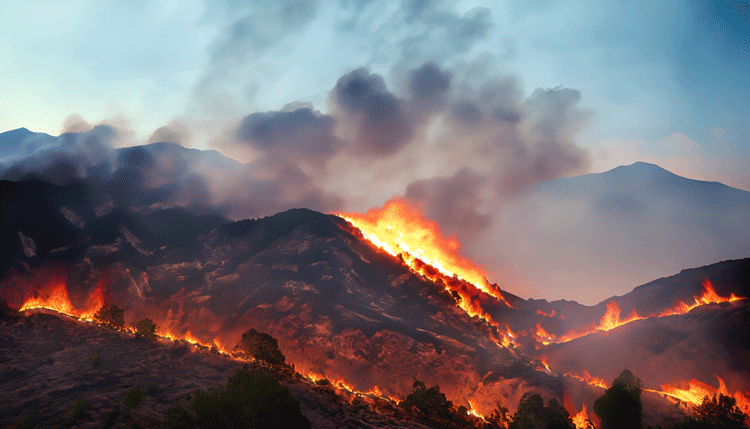
The European Union has deployed assistance in Belgium and Spain following its activation of the Union Civil Protection Mechanism (UCPM), as wildfires continue to affect several parts of Europe.
In Belgium, two aircraft from the EU firefighting fleet, rescEU, were sent from Sweden to Belgium, along with two helicopters from the Netherlands, two from Norway, and two from Germany, in support of local firefighters battling the blaze in the Hautes Fagnes. So far, more than 3,000 hectares have burned.
In Spain, 104 ground firefighters with 36 vehicles from France have come to the aid of Spanish firefighters in the autonomous community of Aragón, where nearly 16,000 hectares have already burned.
The EU also supports emergency services through the satellite mapping system. The Copernicus Emergency Management Service is working on the wildfires in Belgium, Spain, Greece, Germany, Montenegro, Albania, France, Serbia and Italy, providing rapid maps to help authorities assess affected areas and organize the response.
The Commissioner for Crisis Management, Hadja Lahbib, has stated that “no country should face wildfires alone. Through our Civil Protection Mechanism, Europe is swiftly deploying aircraft, helicopters, and firefighters to where they are most needed. This weekend in Belgium and Spain, European solidarity was once again on the ground.”
The 2026 wildfire season is already exceptionally severe. By the end of July, the burned area was already two and a half times higher than usual in Europe. Through the Union Civil Protection Mechanism, countries can quickly draw on a much broader set of firefighters, aircraft, and other emergency capabilities when national resources are under pressure. The European Commission’s Emergency Response Coordination Centre plays a central role in this system: it receives requests for assistance, coordinates offers from member states and participating states, and supports the deployment of the offered capabilities. The Commission also co-finances the deployments.