


Spain and Morocco are neighboring countries condemned to understand each other, even though the recurring migratory incidents seem to say otherwise. If their coasts are only separated by 14.4 kilometers in the Strait of Gibraltar, their economies are deeply intertwined: trade exchanges exceeded 22 billion euros in 2025 while Spain is the world’s third-largest investor in Morocco.
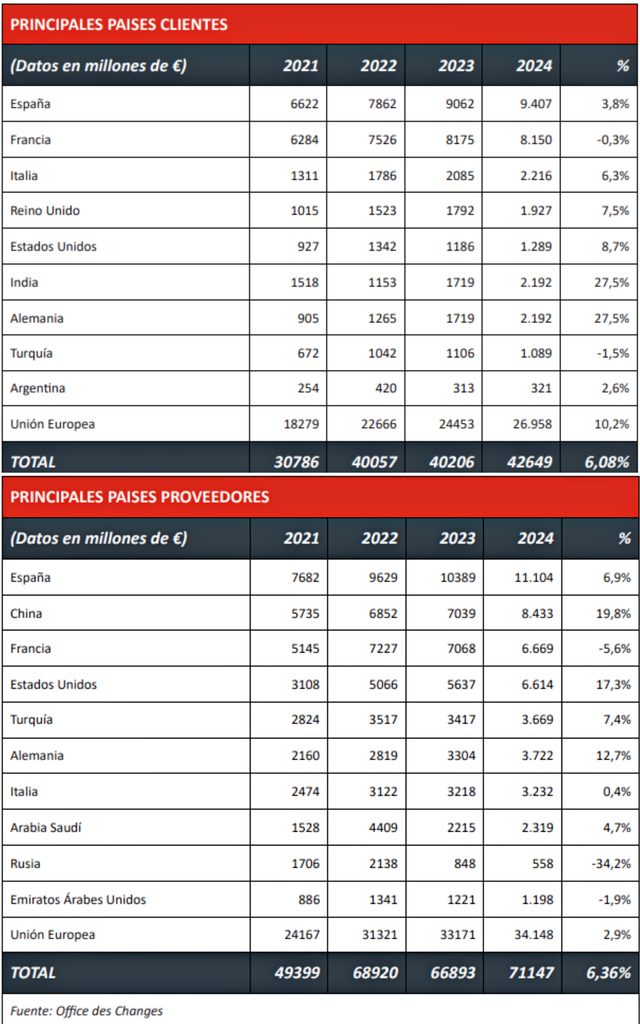
In 2025, according to data from the International Trade Centre, Spain remained Morocco’s primary trading partner, both as a customer and as a supplier. Data provided by the Economic and Commercial Office of Spain in Rabat regarding that year shows that trade between the two countries reached a volume of 22.757 billion euros, of which 12.330 billion correspond to exports from Spain while Moroccan sales amounted to 10.427 billion.
Morocco has thus become the third market for Spanish products outside the European Union, only behind the United States and the United Kingdom. A market in which 15,000 Spanish companies operate, of which more than 6,000 are regular exporters.

Regarding the companies that have settled in Morocco, according to data from the Commercial Office in Rabat, as of December 31, 2024, the Spanish Commercial Registry recorded 669 companies with at least 10% of the capital of Moroccan companies and 527 Moroccan companies that are subsidiaries of Spanish companies and therefore have more than 50% of their capital in Spanish hands.
Considering these capital volumes, the stock of Spanish investments in Morocco amounted, according to the latest available data, that of 2024, to 2.508 billion euros. and directly employs approximately 30,000 workers throughout the country. Its effect on indirect employment, although there are no statistics on this, can triple, according to some Spanish business associations in the country.
The main characteristic of these investments is that, in many cases, they consist of a large number of small contributions, which, according to the Commercial Office of Spain in Rabat, “provides a certain stability to the total figures, in addition to a relative sectoral diversification.”
Spain has been consolidating over the years in the third position among the largest investors in the Moroccan economy despite other countries —such as the United Arab Emirates or Germany— significantly increasing their investments. Morocco is the primary destination, far ahead of others, for Spanish investments in Africa, which total a cumulative 2.3 billion euros.
On the other hand, although Moroccan investments in Spain are much more modest —as of December 31, 2024, they amounted to 193 million euros— on this side of the Strait, more than a million Moroccans work and live. And a large part do not consider a temporary stay. Many have already purchased homes: they accounted for 6.1% of all sales transactions to foreign citizens in 2024, according to media such as ‘Le 360’ or ‘InfoMediaire’, being the third nationality that carried out the most real estate purchase transactions. To complete the picture, this group sent from Spain in 2025 remittances to their families worth almost 1.6 billion euros, approximately equivalent to 1% of Moroccan GDP.
With this data in hand, it is evident that the economic relationship between Spain and Morocco is very deep and too important to jeopardize it due to the strange insistence of some Moroccan elites to claim the Moroccan identity of Ceuta and Melilla. As noted in February 2025, at a business meeting in Rabat, the co-chairman of the Morocco-Spain Economic Council, Adil Rais, “we are structurally very important trading partners for each other.”
At that meeting, attended by the Secretary of State for Trade, Amparo López Senovilla, opportunities for Spanish companies in joint projects were discussed, focusing on shared challenges and regional development such as the 2030 World Cup.
In light of all this, many Moroccans do not share the periodic conflicts provoked from Rabat. “Why risk a mutually beneficial relationship knowing that Ceuta and Melilla will never be ours?,” asks a Moroccan source who prefers to remain anonymous. The answer is evident: “Every time we have a clash, whether due to Algeria, the Sahara, or any other reason, the Rabat regime can express its disagreement and pressure for compensation, if you want to call it that,” adds the same interlocutor.
Certainly, what is most visible about Morocco is its ability to create migratory problems for Spain. However, there are other less visible but much more important details in economic terms.
Starting with the presence of Spanish companies that have invested and settled in the country. To name just a few, decades ago El Corte Inglés —which maintains its technical control office there—, Inditex —which imports part of its production— or Caixabank —which has branches in Casablanca, Tangier, and Agadir— decided to establish themselves in Morocco. But there are more.
To the list of the “big ones,” we must add Abener-Abengoa Water —combined cycle solar thermal plant in Ain Beni Mathar and desalination plant in Agadir—; Acciona Energía —solar thermal plant in Ouarzazate—; Acciona Agua —desalination plant in Casablanca—; CEPSA —fuel supply to fishing boats in Agadir, investment in service stations, and acquisition of the companies Sorexi and Bitulife—; ENDESA —combined cycle plant in Tahaddart—; ROCA —production and marketing of ceramics and sanitary ware—; Banco Sabadell —branch in Casablanca—; Banco Santander —5% stake in Attijariwafabank, the country’s main bank—; Garrigues —legal and procedural services, accounting and tax advice—; INECO —feasibility studies for the Tangier-Tetouan and Tangier-Casablanca railway lines—; Editorial Planeta —has founded a university campus and invested 8 million euros in its Moroccan subsidiary—; ALSA —urban and intercity transport in Agadir, Marrakech, Tangier, Casablanca, Khourtaga, and Rabat—; CAF —contractor for high-speed railway rolling stock—; Iberia —representative office in Casablanca— and hotel chains Barceló, Eurostars, Iberostar, Meliá, and RIU, which manage about twenty hotels in various cities of the country both in ownership and in collaboration with Moroccan companies.
These are just some economic data provided by the country profile published by the Spanish Ministry of Foreign Affairs on its website. But there are many more companies, including small and medium-sized ones, that take advantage of the proximity of the Maghreb country and the tax and labor advantages it offers to foreign companies to develop their production.
The sectors with the greatest Spanish presence in Morocco are tourism, hospitality, energy, technology, infrastructure, fashion and textiles, agro-industry, professional services, and banking.
In the agri-food sector, where more than 10% of Spanish companies operate, the presence of numerous Spanish horticultural SMEs that exploit farmland in areas such as Larache and Agadir stands out, exporting mainly to Europe, including Spain itself. Another paradox of the economic relations between both countries that, between crisis and crisis, will repeatedly confirm that they continue, and will continue, to need each other.