


In the year 1258 B.C., the Treaty of Peace of Kadesh was signed, the first peace treaty in history between the Egyptian Empire, under Pharaoh Ramses II, and the Hittite Empire, ruled by Hattusili III, with beneficial consequences for both territories.
Not only the Peace of Westphalia (1648), the Treaty of Utrecht (1713), the Treaty of Versailles (1919), the agreements of the Peace of Cateau-Cambrésis (1559), or the Peace Agreement with the FARC in Colombia (2026), among others, changed history and the borders of the world. Not only have the agreements for lasting peace been due to the pacifying evolution of man (recently a bit forgotten, that is true).

Among the greatest feats of Pharaoh Ramses II (The Great, 1279-1213 B.C.) is not an act of war but of peace: the signing of the first peace treaty in history. An agreement signed with the Hittite Empire, back in the year 1258 B.C., that ended a long period of ‘visits’ by the latter in Egyptian territory and the Battle of Kadesh of 1274 B.C.
According to Joshua J. Mark, co-founder and content director of World History Encyclopedia, ‘in the fifth year of his reign, the young Pharaoh Ramses II marched from his city Pi-Ramses (‘The House of Ramses’) to Syria to secure the city of Kadesh, a valuable stop on the trade routes of that time. The king of the Hittites Muwatalli II (1295-1272 B.C.) had been making regular incursions into Egyptian territory for some time and, after fortifying Kadesh, had become more of a threat than a nuisance to Ramses II.’
Around 1530 B.C., the Hittites of Anatolia had been growing in power since the second millennium B.C., until they replaced Babylon as a prominent kingdom and began to test the strength of their neighboring country, Egypt. ‘Some letters of intent were sent to Pharaoh Akenaton (1353-1336 B.C.) belonging to the XVIII dynasty,’ continues describing Joshua J. Mark, ‘but he never responded nor realized the Hittite activity along his borders. Akenaton’s General, Horembeb (who would become Pharaoh from 1320 to 1292 B.C.), had conducted an unsuccessful campaign against the Hittites and by the time of Tutankhamun (successor of Akenaton in 1336 B.C.), they had become even more powerful and were bold enough to fortify regions on the borders of Egypt or near it.’
Once Horembeb became Pharaoh in 1320 B.C., he initiated a more aggressive policy against the Hittites and secured the borders of Egypt, but never definitively resolved the problem of Hittite incursions. ‘Seti I (1290-1279 B.C.) had secured Palestine and Kadesh for Egypt but, content with victory, had taken no measures to maintain the city in his power. Now Ramses II, of the XIX dynasty, had to face the problem of the Hittite invasion and in 1274 B.C., gathered his forces in Pi-Ramsés to expel the Hittites from Kadesh and defeat their army,’ according to the historian’s account.
And in this episode, something occurred that has been repeating itself to this day. Depending on which historical source you read, it is not well defined who won the battle. Pharaoh Ramses II boasts in his writings of a triumph with him mounted in his chariot at the head of his division (about 20,000 men). Meanwhile, Muwatalli II describes his triumph over the enemy as he awaited the Egyptians just above a hill at the entrance of Kadesh with 3,500 chariots and 37,000 men.
‘Ramses II failed to achieve his objective of besieging the city, but he shattered the Hittite army in the field, while Muwatalli II retained control of Kadesh but could not crush the Egyptians as he had hoped,’ notes Joshua J. Mark.
In 1237 B.C. Muwatalli II passed away and the Hittite throne was taken by Muwatalli III, signatory of the Treaty of Peace of Hadesh alongside the Egyptian Pharaoh. A treaty that stated: ‘Ramses, the great king, the king of the land of Egypt, will never attack the land of Hatti to take possession of a part (of this land). And Hattusili, the great king, king of the land of Hatti, will never attack the land of Egypt to take possession of a part (of that land).’ In this document, moreover, mutual assistance between the two kingdoms is reached and an extradition treaty is recorded, with the obligation to ‘extradite’ citizens who enter irregularly into each country for their delivery to the neighboring kingdom. It was agreed that those of lower rank could return to their country without suffering reprisals. Although this did not apply to high-ranking officials. And as a conclusion, the content of the treaty committed not only Ramses and Hattusili but also their descendants.

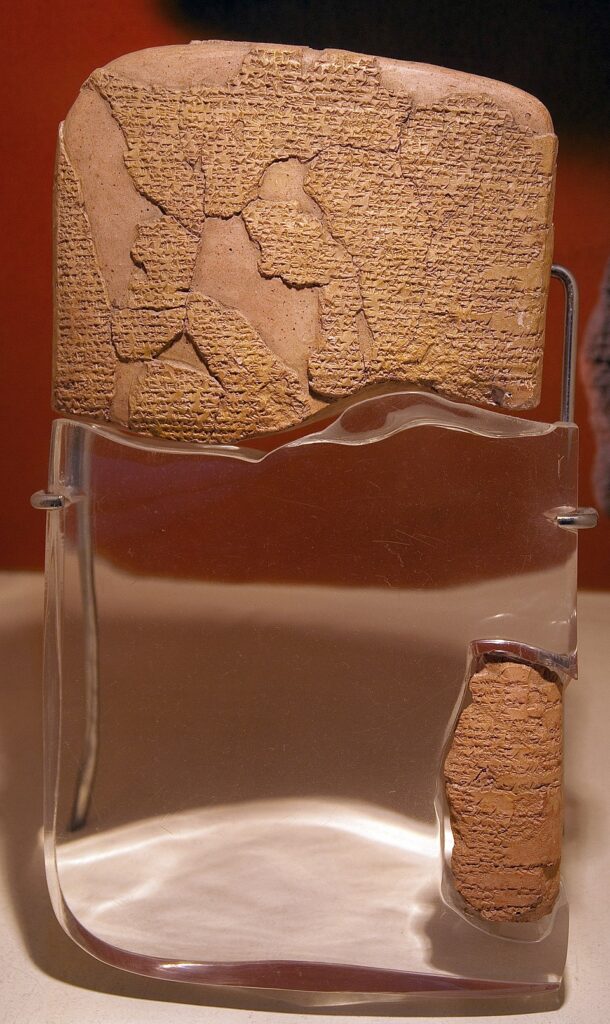
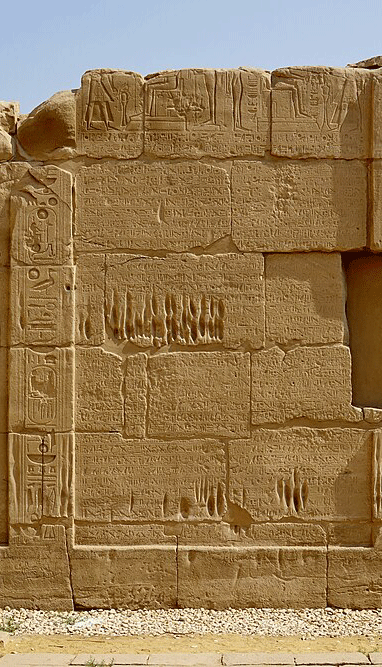
After its signing, a copy was deposited at the feet of Ra and inscribed in the temples of Ra and Amun in Karnak, once transcribed into Egyptian. Another copy was deposited in the temple of Teshub in Hattusas.
The two kings came to realize that neither could gain a substantial advantage over the other and that the best path to choose was the path of peace. Over the years, the Hittites and the Egyptians established a new relationship between them in which they shared their knowledge and experiences, instead of exchanging blows on the battlefield. The Hittites were experts in metallurgy and taught the Egyptians how to manufacture superior weapons and tools, while the Egyptians, masters of agriculture, shared their knowledge with the Hittites.
Later, in 1256 B.C., corresponding to the 24th year of Ramses’ reign, the Pharaoh and the Hittite king consolidated the treaty through blood ties: Hattusili’s daughter was sent to Egypt as Ramses’ wife, who made her Great Royal Wife with the name Maat-Hor-Nefru-Re.
From the signing of this treaty, Egypt and Hatti remained at peace for approximately 110 years, until in 1190 B.C. the latter was completely destroyed by the Sea Peoples, a group of Bronze Age peoples who migrated to the Near East during 1200 B.C., and who sailed along the eastern coast of the Mediterranean and attacked Egypt during the XIX dynasty and especially in the eighth year of Ramses III’s reign, of the XX dynasty.
Today, the Treaty of Kadesh, a symbol of the first ‘movement for perpetual peace,’ adorns the walls of the Headquarters in New York of the United Nations Organization.