


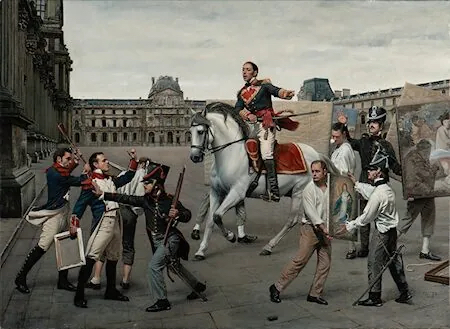
Few people have been able to say that they entered the Louvre Museum and left, boldly, with the works of art they were looking for. Specifically, 3 robberies have been documented —the last one on October 19, 2025— and a “recovery,” absolutely legal, of artistic and historical goods plundered from Spain during the occupation of the Napoleonic troops. The protagonist of this last one: Miguel Ricardo de Álava y Esquivel, general and diplomat.
Recently appointed ambassador in Paris thanks to his friendship with the Duke of Wellington, General De Álava received a direct order from King Ferdinand VII after the scant advances —in reality, none— of the negotiations of Ambassador Pedro Gómez Labrador at the Congress of Vienna for the return of the artistic heritage stolen by the French invading troops to Spain.
De Álava’s operation was, in comparison, a true success, a mix of military tactics and diplomatic strategy of another of the many forgotten characters in Spanish history.
Miguel Ricardo de Álava was one of the most extraordinary military figures that Spain produced in the 19th century. To begin with, he was the only one who participated in and survived the two main battles of the Napoleonic wars: Trafalgar, in which he fought on the Hispano-French side; and Waterloo, where he was on the side of the Duke of Wellington. Such a change of sides was not based on his personal interest, but on the service he was entrusted with at each moment and considered just.
The same happened to him when King Ferdinand VII himself, who granted him titles and honors, persecuted him for his liberal ideas after the absolutist restoration and, immediately after, appointed him ambassador in France at the request of his friend Wellington. Quite normal ups and downs in the tumultuous 19th century Spanish history.
Returning to Paris, and seeing that no return would be achieved through good means, the change of tactics occurred on September 23, 1815. De Álava, the newly appointed head of the Spanish Mission in France, showed up at the Parisian museum to recover the works stolen by the French troops —paintings by Murillo, Zurbarán, Velázquez, or Titian, among others— during the invasion of Spain.
Álava politely requested permission from King Louis XVIII to recover the goods stolen by the French soldiers. Quite timid —and a little intimidated— the French monarch responded that “I neither give it, nor oppose it.”
With such a cryptic response, Álava understood that he had permission and, accompanied by 200 British and Prussian soldiers lent by his friend the Duke of Wellington, he boldly entered the museum. The protests of its director, Viviant Denon —a character who was part of the “commission” that selected the works to be plundered in Spain— only served to delay the recovery by 24 hours, especially because he had gathered a hostile crowd of Parisians at the museum doors.
As it was not the time to provoke a bloodbath, Álava decided on a tactical retreat after recovering barely a dozen works. But the next day, early, he returned. And this time he secured more than 280 works, after threatening to literally empty the gallery if Vernon continued to oppose.
The Frenchman understood the message. This time he was not on the winning side, but rather the opposite, and he had also been unable to gather the mob, as he had the day before. In summary, he could not resist any longer and Álava recovered, without any violence, 300 works of Spanish heritage that were packed in 13 crates and sent to Antwerp, where they were shipped to Spain. This route was chosen to avoid crossing France, where the convoy could be attacked at any moment.
Among the recovered works are “The Holy Family” by Raphael and “The Dream of the Patrician Juan” by Murillo. But not all looted goods could be recovered, as happened with those personally stolen by Marshal Soult. For example, “Saint John Exorcising the Demon”, by Alonso Cano, or “Saint Basil Dictating His Doctrine”, by Francisco Herrera ‘the Elder’, remain in the Louvre.
Others, such as “Abraham and the Three Angels”, by Murillo; “The Immaculate Conception”, by Velázquez; or “The Tribute to Caesar”, by Titian, are exhibited in the National Gallery, as the English also took advantage of the definitive Napoleonic defeat to loot the French museums, from which they also took pieces like the “Rosetta Stone.” The “civilized” powers of the 19th century did not stop plundering each other for decades.
Miguel Ricardo de Álava y Esquivel was a deputy and president of the Cortes, but surely his greatest satisfaction was that the Academy of Fine Arts of San Fernando appointed him honorary academic for his “efforts” to recover the works of art looted by Napoleon’s troops. Thanks to this, the Prado Museum is now one of the main art galleries in the world.