


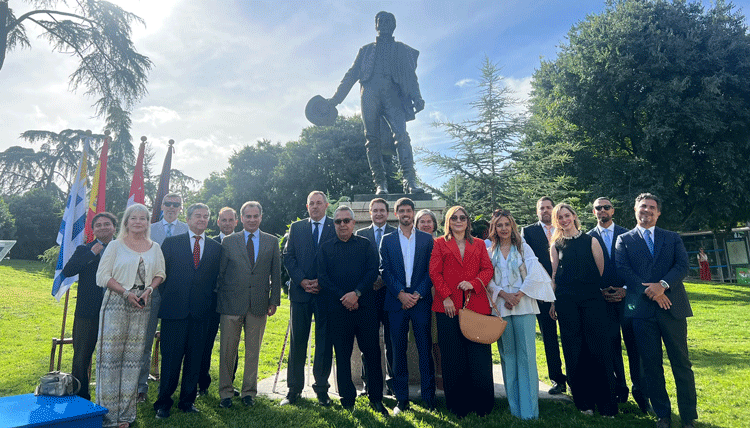
“Today Uruguay and Spain are an example of shared will, in political dialogue, in cooperation, culture, in the economic relationship and also in the drive that both give to strengthening the link between MERCOSUR and the European Union,” said Uruguayan ambassador Bernardo Greiver at the celebration of the 201st Anniversary of the Independence of the South American country.
The monument to the Hero José Artigas in the Parque del Oeste in Madrid received a floral offering yesterday organized by the Embassy of Uruguay to celebrate this worthy anniversary, which was attended by a large number of members of the Diplomatic Corps.
The Uruguayan ambassador, Bernardo Greiver del Hoyo, stated that with this act “the values of freedom, democracy, and coexistence are reaffirmed and we do it alongside friends in Spain, diplomatic colleagues, and attachés from the Foreign Ministry and Embassies, and especially alongside our community.”
Subsequently, the ambassador highlighted the ideals represented by the figure of José Artigas, “which remain fully valid, because they are part of our way of understanding the Republic and building our future.”
Bernardo Greiver emphasized several phrases from the Uruguayan Hero, including: My authority emanates from you and it ceases before your sovereign presence, which means “democracy, citizen participation, and legitimacy born from the popular will.”
We should expect nothing but from ourselves. It means, according to the Uruguayan ambassador, “taking responsibility for our own development, trusting in our capabilities and in the work of our people. Let the most unfortunate be the most privileged. It means, he comments, “inclusion, equality of opportunities, and the permanent commitment that progress reaches everyone.”
He also highlighted the Artiguist concept of Free Peoples, which “means cooperation among equals, regional integration, and mutual respect.” To conclude by indicating that that ideal of José Artigas that Let the Easterners be as enlightened as brave, means “understanding that the true progress of a nation arises from the union between knowledge and character. That courage allows us to overcome challenges, but it is education that enables us to sustain and project ourselves. It means a society that forms free, critical, and innovative citizens; that makes science, culture, and education the pillars of its development; and that the greatest wealth of a country is not only in its natural resources but in the talent and preparation of its people,” continued ambassador Bernardo Greiver.
The Uruguayan ambassador pointed out that the state of Uruguay was born from a “complex political, military, economic, and diplomatic process. From its very genesis, it understood that its international insertion would be an inseparable part of its identity. That is why foreign policy and the vocation for dialogue have been part of our history since the very birth of the Republic. We take pride in having made democracy a form of coexistence and that Uruguay is recognized among the most solid democracies in the world. We take pride that respect for the law is a state policy; that dialogue is our way of relating to the world; and that institutional, political, economic, legal, and social stability constitutes one of the main assets of our country. Likewise, that for the vast majority of days of the year our electricity comes from renewable sources, demonstrating that in Uruguay, development and environmental care can advance hand in hand.
Regarding relations with Spain, the Uruguayan ambassador stated that “we are united by centuries of shared history. We are united by millions of family stories. And we are united by a friendship that time has only strengthened. In a world where uncertainty and confrontation too often prevail, Uruguay and Spain continue to believe in the value of understanding and we provide certainties. Two hundred years ago, a country was born that demonstrated that values can be greater than territory and that the coherence between principles and actions constitutes the most valuable heritage of a nation. That has been, to a large extent, the history of Uruguay.”