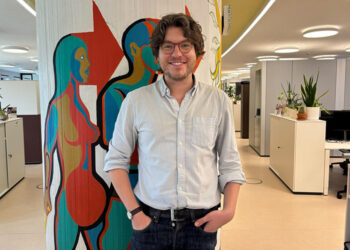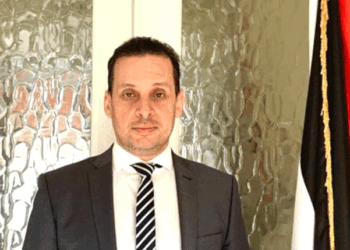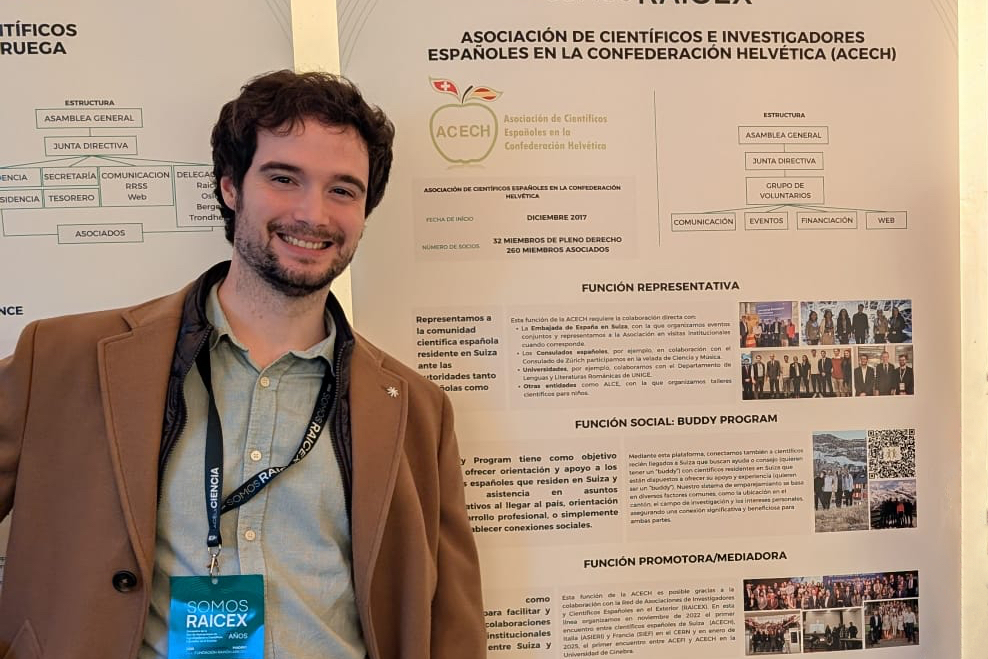
The approval of the new European framework for scientific diplomacy in May 2026 has strengthened the recognition of networks as key actors in international scientific cooperation. RAICEX (Network of Associations of Researchers and Spanish Scientists Abroad) has been advocating for greater integration of the diaspora in science, internationalization, and foreign action policies, as well as the strengthening of Spanish scientific diplomacy. We spoke with Javier Cabello García, member of the Commission for Policy and Scientific Diplomacy of RAICEX.
Based on the diagnosis you made in the ATRAE report, marked by difficulties in attracting and retaining talent, an unstable research career, and incomplete internationalization, what aspects remain critical today and in which areas have you observed any evolution?
The diagnosis of ATRAE remains valid in essence. Many scientists, both young and not so young, continue to leave the country, and the instability of the research career persists. Nevertheless, since the publication of the report, there have been relevant advances, of which we highlight two in which we have participated.
The first is the strengthening of the aid aimed at attracting and consolidating researchers in Spain (Ramón y Cajal Program). Now a single call finances both the salary of the researcher and their own research project for five years. This provides more stability, facilitates the development of personal projects, and favors the consolidation of a scientific career in Spain. In addition, it encourages participation in European excellence calls such as those from the ERC.
The second advance refers to the recognition of foreign degrees. A Royal Decree is being processed that foresees a centralized body and the automatic recognition of doctorates from the EEES and countries with bilateral agreements. We view this direction positively, although we will have to wait for the final text. However, difficulties persist for doctorates obtained outside the EEES.
How is Spanish scientific diplomacy articulated as an ecosystem, and what role does the scientific diaspora occupy within it?
Spanish scientific diplomacy brings together a significant number of actors, with coordination still improvable. The Ministry of Science, FECYT, AECID through the cultural and scientific action of embassies, CDTI, public research organizations, autonomous communities, and the diaspora, organized through RAICEX, are involved.
In RAICEX, we bring together 22 associations of Spanish scientists spread across more than forty countries, including CERU in the United Kingdom, ECUSA in the United States, or CENL in the Netherlands. Each association maintains permanent ties with leading institutions in their country and generates collaborations and talent flows in both directions. We act as a regular interlocutor, and our role is real. However, there is a general perception of underutilization. Our work is voluntary, unpaid, and barely institutionalized. Moreover, we are consulted sporadically, not structurally, with scientific advice mostly falling on agents located within Spain. Thus, the connections and direct knowledge of those working abroad and who are familiar with other scientific systems are underutilized.
What notable differences do you find between the Spanish model of the relationship between science and foreign action and that of other countries with which you regularly work?
The difference lies in the distribution of functions. There are well-recognized institutions like ICEX, which covers trade and investment, and CDTI, which covers business innovation and industrial technological cooperation. Academic science, the university, and the diaspora are left to the Cultural and Scientific Councils, which share portfolios, and a few FECYT coordinators. Nearby examples, such as Switzerland, Germany, or the United Kingdom, integrate education, research, and innovation into a single structure. In Spain, these functions remain dispersed among different agencies and levels of administration.
How do you assess the new framework on Scientific Diplomacy recently approved by the EU?
We assess it positively. For the first time, the EU sets a common vision and a code of conduct for scientific diplomacy and supports one of RAICEX’s historical demands: to recognize and support grassroots associations of the diaspora, which are currently underfunded and face continuity challenges due to their voluntary nature.
It is advisable, however, to be realistic. It is a recommendation, not a binding norm, and its impact will depend on how member states apply it. Spain has credibility in this area thanks to its involvement in European scientific diplomacy initiatives, and there are several encouraging signs, such as FECYT’s participation in the European project CUSP (Consolidating European Science Diplomacy), a European project funded by Horizon Europe to turn this framework into concrete actions.
And in what areas does the new framework seem insufficient regarding the real challenges of the system?
The new framework succeeds in its objective but leaves important issues unresolved. First, although it admits that structural support for networks is necessary and to leverage their advisory role, it does not suggest or assign them a concrete plan for it. Second, the framework relies on existing programs; it does not provide its own funding or metrics of its own impact, risking becoming a mere statement of intent. Third, the framework promotes attracting talent to Europe, but reintegration into each system, in our case the Spanish one, remains unresolved. This is the pending subject that no European recommendation will replace.
Beyond the new European framework, what changes do you consider necessary for scientific diplomacy to consolidate as a structural axis of the Spanish system of science and foreign action?
In RAICEX, we propose three changes. The first is governance, following a model similar to the Swiss one: a shared strategy between Science and Foreign Affairs, with multiannual objectives and its own budget, that coordinates the action currently dispersed among ICEX, CDTI, FECYT, AECID, and the autonomous communities. For external associations to the Spanish system, coordinating with such a fragmented ecosystem is complex, especially when different institutions pursue objectives that are not always aligned.
The second: recognize the diaspora as a stable interlocutor, with permanent forums and a direct channel with both ministries. And open concrete avenues for contribution, not just return; those who do not return to Spain can also contribute to the system. The diaspora constitutes a network of more than forty countries and can expand the reach of any initiative at low cost. The fact that nearly 4,500 scientists have organized autonomously and altruistically indicates that there is a willingness and a resource to develop.
The third, coherence between priority and means. If Foreign Affairs considers scientific diplomacy a priority, it must provide it with its own presence in key embassies, not a shared portfolio with culture. Today, that declared priority does not translate into resources and often falls on the diaspora, which is voluntary and unpaid, making unsustainable individual efforts in the long term.
What figure do you consider most effective to ensure communication between the scientific and diplomatic worlds?
It would be necessary to have personnel with a scientific profile, trained in scientific diplomacy and with stable dedication in priority embassies. The closest figure would be the scientific coordinator that FECYT piloted in London, as it ensures sustained communication and prevents everything from depending on the legislature, the will of the ambassador, or the altruistic work of the diaspora. The London pilot itself demonstrated the value of combining a FECYT coordinator, a diaspora association (CERU), and programs to create shared culture, such as ‘Ambassadors for Science.’ Today, London is one of the most active nodes of the Spanish scientific community abroad.
How is the tension between openness and protection of knowledge managed, and what kind of real margin exists today for international collaboration?
This tension is currently managed with little clarity and much uncertainty. Those researching abroad experience it daily. The new European framework proposes a sensible principle: as open as possible, as closed as necessary. The problem lies in the ambiguity in its application, which depends on the country and the institution.
The margin for international collaboration remains broad in most fields. There has been particular scrutiny on critical and dual-use technologies, such as anything related to AI or quantum technology. In those fields, caution is sometimes applied in a draconian and unpredictable manner, as has recently occurred with the latest models from Anthropic. We understand the need for protection, but poorly calibrated restrictions can affect adjacent fields, hindering collaboration and breaking consortia that take years to build. And here the diaspora contributes something concrete. They know firsthand the security frameworks of the countries where they work. They can help Spain calibrate the real risk without renouncing the openness that makes science competitive.