The Community of Latin American and Caribbean States (CELAC), the main regional political forum that brings together 33 nations from Latin America and the Caribbean, begins a new stage under Uruguayan leadership. President Yamandú Orsi assumed the pro tempore presidency of the bloc for the first time after receiving the handover from his Colombian counterpart, Gustavo Petro, at a summit held in Bogotá.
This handover symbolizes the continuity of the regional commitment to integration, multilateralism, and projecting a unified voice of Latin America and the Caribbean on the international stage.
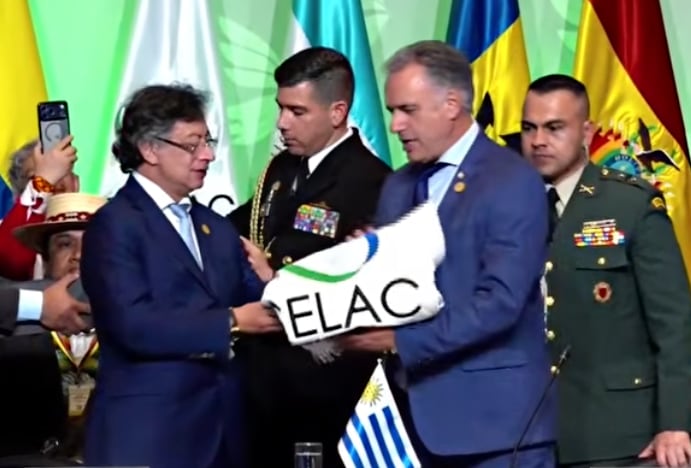
The X Summit of CELAC, held in Bogotá on March 21, 2026, culminated with the formal act of handover of the pro tempore presidency of the organization from Colombia to Uruguay. In the presence of other regional and global leaders, Colombian President Gustavo Petro handed Yamandú Orsi a gavel that symbolizes the authority of the bloc and the CELAC flag, marking the beginning of the Uruguayan mandate. It is the first time that Uruguay has taken the lead of this regional mechanism since its creation in 2011, an event that underscores the inclusive and rotating nature of CELAC as a space for dialogue and concertation of all Latin American and Caribbean countries (33 States, without participation from the United States or Canada).
Orsi, President of Uruguay, assumed the pro tempore presidency for the 2026-2027 period highlighting the peaceful vocation of the region. “Our region made a profound political decision some time ago, to choose peace, not as an empty slogan, but as a living way to build freedoms”, stated the new head of CELAC during his acceptance speech in the Colombian capital. He also assured that Uruguay faces leadership with the commitment to strengthen regional dialogue and cooperation and to advance in priority areas for the bloc, such as food security, energy transition, regional interconnection, and productive development.
The Uruguayan president also warned about some internal challenges in the region: the high levels of violence that persist in Latin America and the Caribbean despite the absence of armed conflicts between States. “With only 8% of the world’s population, Latin America and the Caribbean account for more than 30% of the world’s homicides”, Orsi pointed out, emphasizing the need to jointly confront transnational crime (especially drug trafficking and arms trafficking) through coordinated responses among countries. Likewise, the Uruguayan president called to support the most vulnerable States in the area, citing the case of Haiti as a priority for regional stability, and advocated for strengthening Latin American and Caribbean articulation in multilateral forums.
The handover of the CELAC presidency also marked the end of Colombia’s management during 2025-2026, a period that, according to experts, boosted the international projection of the bloc. During its presidency, Colombia promoted an agenda of extra-regional alliances: birregional dialogues with the European Union were resumed, materialized in the holding of the IV CELAC–EU Summit in Santa Marta (Colombia) at the end of 2025. There, it was agreed to outline a CELAC-EU cooperation roadmap (Santa Marta Vision) with the aim of deepening the birregional partnership, a task that Uruguay will have to continue in 2026 until its presentation at the UN in New York. Similarly, the Colombian presidency coordinated the organization of the IV CELAC–China Forum (Beijing, May 2025) and, for the first time in the history of the bloc, a high-level meeting between CELAC and the African Union in Bogotá. This last meeting, held parallel to the handover summit, involved leaders from 19 African countries, demonstrating CELAC’s willingness to extend its South-South cooperation links beyond the Americas.
In the context of this handover, the Colombian Foreign Ministry issued a statement highlighting that the 33 member States worked during Petro’s presidency to follow up on an ambitious common agenda in terms of integration and to prepare for the transition of power to Uruguay. The willingness for institutional continuity was confirmed with this orderly handover, despite the political diversity of the region and a historic period of inactivity in 2018-2019 when CELAC failed to gather its leaders due to internal disagreements. The momentary reluctance of Brazil, which suspended its participation under a previous government in 2020, and its reincorporation in 2023 under Luiz Inácio Lula da Silva illustrate the overcoming of divisions and the consolidation of the commitment of all countries to CELAC.
After a decade and a half of existence, CELAC has consolidated itself as the main forum for regional political concertation and as a collective interlocutor for Latin America and the Caribbean with external partners. Uruguay, a traditional defender of multilateralism and cooperation on the international stage, now leads the bloc with the mission of deepening regional integration and strengthening CELAC’s credibility as a unified actor in the world. The expectations surrounding its pro tempore presidency have been heightened by the trust placed in Montevideo to lead, for example, the implementation of the action plan agreed with the European Union and the strengthening of CELAC–Africa cooperation. In the words of the new regional leader, Uruguay will seek to “add efforts” so that CELAC “continues building bridges of dialogue and unity” among its members and with other regions, for the benefit of “our peoples.” Thus, the handover of the CELAC presidency from Colombia to Uruguay represents a key institutional transition that combines continuity and renewal, placing the region before the opportunity to strengthen its internal unity and reinforce its diplomatic prominence on the global stage.