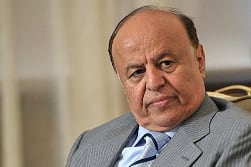
Abdelrabo Mansur Hadi, who was president of Yemen for a decade until 2022, passed away a few days ago at his residence in Riyadh at the age of 80. Hadi led a weak government backed by Saudi Arabia, which he largely directed from exile.
An old general of the Yemeni army trained in military academies in England, Egypt, and the Soviet Union, Hadi became president in 2012 after having played a long time a discreet role as vice president of Ali Abdullah Saleh, whose 33 years in power ended as a result of the uprisings that originated during the Arab Spring, to which was added the growing discontent of broad sectors of Yemeni society.
The difficulties during his mandate were not long in coming. Just a few hours after his inauguration in Sana’a – after an election in which he was the sole candidate and obtained 99% of the votes – a suicide bombing by AQAP, the Yemeni branch of Al Qaeda that already controlled extensive areas of southern Yemen at that time, resulted in the death of 26 soldiers in the port city of Al Mukalla. This brutal attack would be the prelude to what was to come: a brutal civil war that, to date, has caused more than 375,000 deaths and an unprecedented humanitarian crisis.
Many agree that the high point of Hadi’s presidency – and the one that raised the most hopes of avoiding the total conflict that would later erupt – was the National Reconciliation Conference, promoted by the president himself in 2013 with the aim of laying the foundations for a new political pact for Yemen. The process was supported by the United Nations and was described by the then UN special envoy, Jamal Benomar, as “a historic moment.” However, internal divisions, combined with the rejection of the northern Houthis and the southern separatists to the proposed federal plan, would ultimately frustrate expectations, leading to the exhaustion of the process in February 2014.
A few months later, in an unexpected turn of events, the Houthis, supported by former president Saleh, in an alliance as unexpected as it was circumstantial, staged a coup and, in September 2014, took Sana’a, occupying several ministries and precipitating Hadi’s resignation and subsequent flight, first to Aden and then to Riyadh. From exile, Hadi requested the help of several Arab countries to regain power. The response was the creation of a coalition led by Saudi Arabia and the United Arab Emirates, which launched Operation Decisive Storm in March 2015, conceived with the dual objective of restoring Hadi’s government and stopping the Houthi advance. This intervention would end up internationalizing the conflict and transforming an internal political crisis into a devastating civil war.
As the conflict became entrenched, Hadi’s government lost political relevance. From Riyadh, the president directed an administration increasingly detached from Yemeni reality. Various observers denounced frequent ministerial changes, internal struggles for power sharing, and nepotism practices reminiscent of Saleh’s regime, with numerous public positions occupied by people from Abyan – Hadi’s home province – as well as by his relatives and close associates.
Hadi was also criticized for not intervening in issues that he could have addressed relatively easily from Saudi Arabia, such as the blatant case of the expulsion of tens of thousands of Yemeni workers from the country due to the Saudization aimed at replacing foreign workers with national citizens. The remittances sent by these workers constituted an essential source of income for many families – and even entire communities – in Yemen, a country devastated by war. However, Hadi barely used his influence with his host, King Salman, to look after the interests of his compatriots.
Another of the most controversial aspects of his presidency was his support for the military campaign of the international coalition. Although initially many Yemenis saw this intervention as an opportunity to stop the Houthi advance, over the years it became evident that the bombings would not achieve a decisive victory. Meanwhile, hospitals, roads, factories, and other vital infrastructures of the country suffered irreparable damage. Furthermore, criticism of Hadi increased as the perception grew that Saudi Arabia and the United Arab Emirates were developing their own agendas in Yemen with little oversight from the government they were supposedly supporting.
The enormous human cost of the war, combined with its economic impact and the change in Saudi Arabia’s strategic priorities, ultimately altered the political landscape. The easing of diplomatic relations between Saudi Arabia and Iran – the main support of the Houthi rebels – along with Crown Prince Mohammed bin Salman’s interest in concentrating resources on his Vision 2030, propelled the search for a negotiated exit to the conflict that involved a change in Yemeni leadership. Thus, in April 2022, after a UN-sponsored truce with the Houthis, Hadi resigned from the presidency, transferring his powers to a Presidential Leadership Council, headed by one of his former advisors, Rashad al-Alimi.
Shortly after going into exile, Hadi expressed his desire to someday see a unified Yemen governed again from its historic capital. However, in the ten years of his presidency, he failed to lead his country towards the peaceful and democratic transition that many expected after Saleh’s fall, nor did he manage to stop a war that has disrupted the lives of millions of people. His legacy will sadly remain tied to a decade of missed opportunities.