Every year, on June 24, the International Day of Women in Diplomacy is celebrated, a date established by the United Nations General Assembly in 2022. Its main objective is to recognize the active participation of women in foreign policy, peacebuilding, and to promote gender equality in international relations.
The American Eleanor Roosevelt, the Israeli Golda Meir, the Indian Vijaya Lakshmi Pandit, or the Armenian Diana Abgar are clear examples that numerous times throughout history women have played a decisive role in global diplomacy. But, since we are in Spain, it is worth highlighting the figure of Margarita Salaverría, the first woman to pass the exams for the diplomatic career in Spain in 1933, paving the way for women in the foreign service.
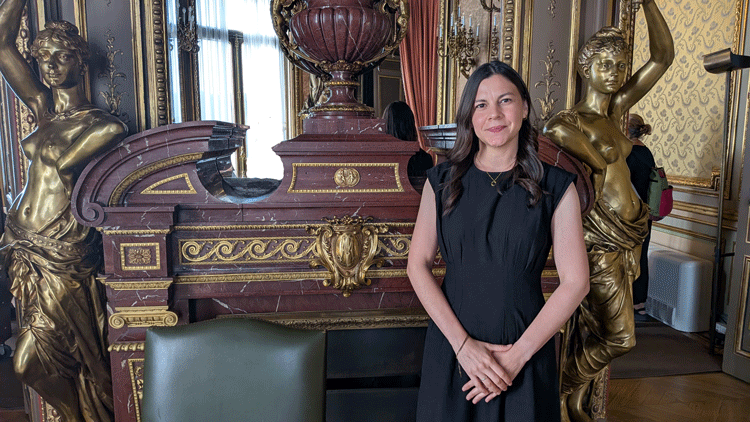
As we reported on June 8 in Diplomacy News, Paraguayan diplomat Andrea Martínez was recognized as “outstanding student” during the graduation ceremony of the Master’s in Permanent Training in Diplomacy and International Relations 2025-2026, taught by the Diplomatic School of Spain, held on June 3 in Madrid.
There is no better way to celebrate this “feminine diplomatic day” than to interview this emerging and prominent diplomat who, as they say in a famous movie, “has undoubtedly earned it.”
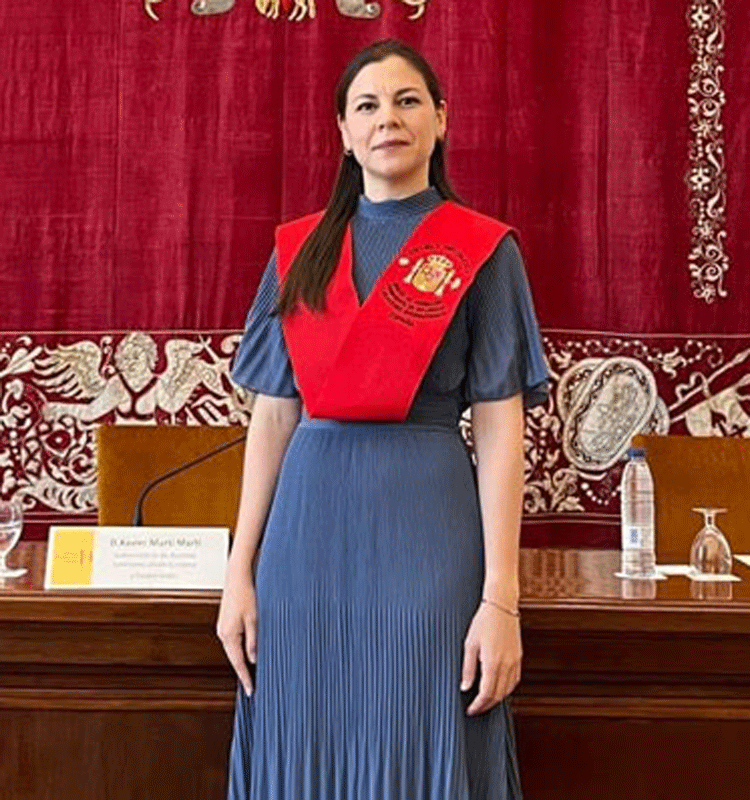
Andrea is a lawyer, notary, and public scribe, graduated from the National University of Asunción, with a master’s degree in Public Affairs and Governance from Columbia University of Paraguay. Currently, she serves as the second secretary of the diplomatic and consular hierarchy at the Ministry of Foreign Affairs of the Republic of Paraguay, appointed as head of Commercial Affairs, Negotiations, and Agreements in the Directorate of Foreign Trade and Investments. Specifically, her work involves being responsible for leading and following up on economic-commercial negotiations at the bilateral level and within the Mercosur framework.
1.- Andrea, what experience or specific moment awakened your vocation for the diplomatic career?
My interest arose from a search for professional and personal improvement. I learned about the Opposition and Merit Contest of the Ministry of Foreign Affairs in my early university years almost by chance, and since then, my inclination has been consolidating as I observed that public competitions were developed in a framework of transparency and equal opportunities for all Paraguayans. It was very important for me, in addition to the demanding preparation required for the evaluations, to see the State’s commitment to building a professional public service, which is not limited to access but extends to rigorous training at the Carlos Antonio López Diplomatic and Consular Academy, where new diplomats must complete two years of preparation once they pass the entrance exams, and which also accompanies us throughout our careers. It was that combination of building a professional public service and the personal merits required that ultimately defined my decision to pursue a diplomatic career.
2.- What skills do you think are vital for the “new diplomacy”?
Diplomacy cannot stray from dialogue as the main tool to achieve understandings, so I believe that having the ability to generate those spaces for exchange remains vital for its optimal functioning. However, we find ourselves in an environment where multiple actors participate, information arrives in real-time, and citizens show greater interest in international events that affect them. The combination of these elements, with the nuance of prudence demanded by foreign service, makes it important for diplomats today to have competencies for articulation, to convey messages accurately, and to understand the constantly changing dynamics.
3.- The profession requires a lot of adaptation: how do you think you will manage the constant change of country and relocations?
The experience in Madrid taking the Master’s in Training is my first approach to adapting to a new city. During this period, I was able to experience firsthand what it means to leave the country, family, and the general idiosyncrasy to which you are accustomed. It is an inherent challenge of the diplomatic career, but it also broadens one’s horizons, allows you to develop new skills, listen to different voices, and see the world from other perspectives. Beyond the destination itself, I believe that the essential thing in that process is to seek the best way to contribute in each place where one works and always maintain a good disposition for learning. I think that attitude can help us better position ourselves in each context and adapt to the changes that arise.
4.- In such a polarized world, how do you manage to defend your country’s interests while maintaining an open and constructive dialogue with other nations?
Open and constructive dialogue is the best alternative when different actors propose different ideas. Diplomacy consists, precisely, in finding the balance between those objectives to strengthen relationships and build understandings. Although the context of action is complex and achieving that balance may not be easy, I believe that keeping channels open is the first step to overcoming the temporary differences that may arise.
5.- What global challenge (climate change, cybersecurity, migration crisis, etc.) do you think will mark the agenda of the next decade?
I believe that the current agenda is not marked by a single challenge, but precisely by the coexistence of several simultaneous fronts that are interconnected. From my perspective, the challenge lies in how to address those specific concerns and in seeking consensus on them, in bringing together different positions and maintaining common frameworks of action that endure over time. That is why I believe that professional diplomacy has an increasingly greater responsibility to propose paths that allow for building understandings on the urgent issues affecting the entire international community.
6.- At the graduation ceremony of 2026, there was talk of projecting a modern Paraguay. What image of the country do you seek to convey in your first destination?
Paraguay has a natural vocation for building bridges, integration, and dialogue, which forges our identity. An essential part of diplomatic work is precisely to build those bridges, invite others to know our people, our culture, and, of course, also to showcase the favorable conditions it offers for doing business, investing, and growing. As a diplomat on a first mission, I believe that the task will be to try to contribute, from the place that I occupy, to those objectives of international projection and development that the country has outlined.