
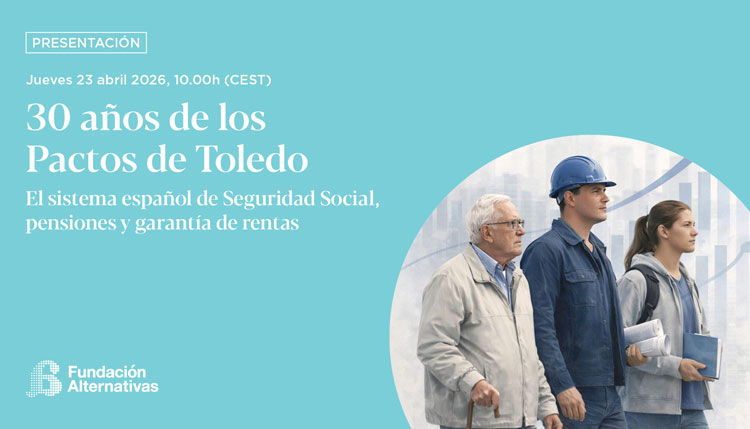
Spain faces the challenge of preserving a model that has guaranteed protection, stability, and cohesion.
Next Thursday, April 23 at 10 a.m., the Fundación Alternativas analyzes the Spanish system of Social Security, pensions, and income guarantee presents its report on the 30 years of the Toledo Pacts, the Spanish Social Security system, pensions, and income guarantee.
At a moment of special significance for the welfare state, marked by the accelerated aging of the population, the transformation of employment, and the emergence of new forms of vulnerability, this report proposes a strategic look at the present and future of the Spanish Social Security system, coinciding with the thirtieth anniversary of the Toledo Pact, a fundamental reference of social consensus in our country.
Thirty years after that agreement, Spain faces the challenge of preserving a model that has guaranteed protection, stability, and cohesion, in an economic and demographic environment more demanding than ever. Financial sustainability, intergenerational equity, reducing the gender gap in pensions, protecting the most exposed groups, and possible ways to complement public pensions are at the center of the debate.
Our country has a solid institutional architecture and extensive reformist experience to tackle these challenges. But consolidating trust in the system requires renewing the political and social commitment that has made it possible and strengthening its capacity for adaptation without renouncing its principles of solidarity and sufficiency.
After welcoming words from Diego López Garrido, executive vice president of the Fundación Alternativas analyzes the Spanish system of Social Security, pensions, and income guarantee, there will be a special intervention by Borja Suárez, Secretary of State for Social Security and Pensions.
Under the title Assessment of the Toledo pacts 30 years later, Carles Campuzano, deputy in the General Courts for Barcelona (1996-2019) and currently Deputy of the Parliament of Catalonia; Adolfo Jiménez, Secretary General of Social Security (1986-1996), and Emilio Olabarría, deputy in the General Courts for Álava (1986-1996 and 2004-2015) will speak. The journalist from elDiario.es, Laura Olías, will moderate.
After a coffee break, at 11:15 a.m., the Report: 30 years of the Toledo Pacts, will be presented with the intervention of Octavio Granado, director of the report and former Secretary of State for Social Security (2018-2020), and the authors of the document, María José Landaburu, Secretary General of the Union of Associations of Self-Employed Workers; María Milagros Paniagua, former Secretary General of Objectives and Policies for Inclusion and Social Protection; José Luis Tortuero; Professor of Labor Law and Social Security at the Complutense University of Madrid, and Paz Menéndez Sebastián, director of the equality area at the University of Oviedo. Professors of Labor Law and Social Security. Octavio Granado and Carlos Bravo, director of the report and Secretary of Public Policies and Social Protection of Comisiones Obreras, will moderate. The event will be closed by Elma Saiz Delgado, Minister of Inclusion, Social Security, and Migration.
Access to the debate can be done by registering at this link or it can be followed on the YouTube channel of the Foundation.