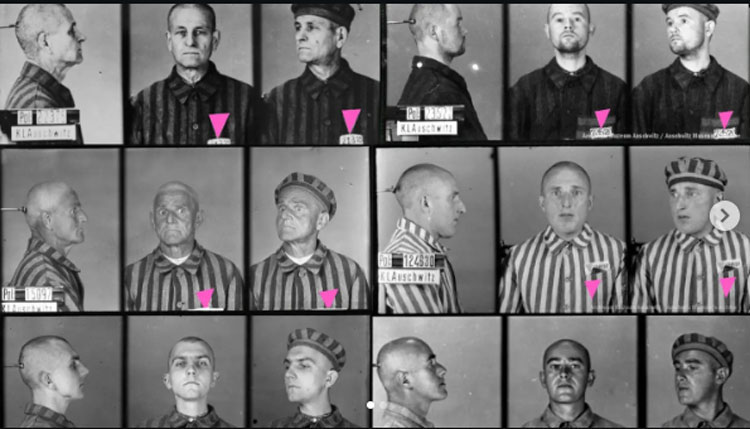
Until the next May 29, at the Meeting Patio of the Alcobendas City Hall (Plaza Mayor, s/n) you can visit the exhibition Pink Triangle. 1933-1945. Homosexuals in Nazi Camps, an exhibition recommended by the Polish Institute of Culture.
This exhibition is the result of the collaboration between the Auschwitz-Birkenau National Institute, the Chair of Human Rights and Democratic Culture at the University of Burgos and the National Museum of the Stutthof Concentration and Extermination Camp.
The persecution exercised by the Third Reich against homosexuals constitutes one of the most invisibilized chapters of Nazi violence. Unlike other groups – such as Jews, Roma, or political prisoners – whose recognition began in the post-war period, homosexual victims remained for decades in a legal, social, and memorial limbo. Not only were they not compensated, but they continued to be persecuted under laws inherited from the Nazi regime in various European countries well into the 20th century.
Thousands of men – as well as their partners, families, and surroundings – were the object of a repressive system focused on sexual normativity and reproduction as a political imperative. The machinery of the Nazi state, through institutions such as the Gestapo, the criminal police, the judicial apparatus, and the penitentiary system, deployed a systematic persecution against those considered ‘deviants.’ This process often culminated in deportation to concentration and extermination camps.
The exhibition route, articulated in 33 panels, begins with the loss of freedoms following the rise of Nazism – in areas such as culture, cinema, publishing, and social spaces – and advances through different axes: the destruction of scientific institutions that supported homosexuals, everyday violence, the internal contradictions of paramilitary groups, institutionalized persecution, the experience in concentration camps, the fate of prisoners after liberation, their incorporation into disciplinary units, and their situation after the end of the war.
The exhibition also includes a section of direct testimonies from survivors of different nationalities. These accounts, marked by silence, fear, and lack of recognition for decades, constitute a documentary corpus that adds a human dimension to the exhibition as a whole.
Furthermore, as part of the program accompanying the exhibition Pink Triangle, next Monday, May 25 at 6 PM, writer and philosophy professor Remigiusz Ryziński will give a lecture titled From ‘Pink Triangles’ to ‘Operation Jacinto’ – archives, memory, community, at the Espacio Miguel Delibes in Alcobendas (Avenida de la Magia, 4).
In the 19th century, the category of ‘homosexuals’ was invented, which designated not so much practices as people and a community subjected to exclusion. The law followed scientia sexualis and established a code in which those fitting the category of ‘exiled’ (to use Zygmunt Bauman’s formula here) automatically became criminals or were considered sick. Lists and classifications were drawn up, detailed descriptions of behaviors and ‘signs’ that accredited belonging to the stigmatized. In the ideal penitentiary system, there was also a space where, under constant surveillance, ‘normalized’ and condemned, homosexual and queer individuals were doomed to annihilation. They could not be visible, they could not leave traces, they could not build their own history, they could not love, gather, meet, or live in their own way. And yet – despite the terror – from the underground they created a community, turned the language of hate into their own jargon, and transformed the norm into their camp travesty. They survived Paragraph 175, Operation Jacinto, the camps, the prisons, and coercion.
In the talk, topics will be addressed regarding the files of homosexuals in interwar Poland, the Magnus Hirschfeld Institute in Berlin, the 1930s, and the application of homophobic laws, as well as Michel Foucault’s surveillance and the ‘pink’ files that were compiled until the 1990s.
Remigiusz Ryziński was a fellow, among others, of the Government of France, the Schuman Foundation, the Nippon Foundation, the Capital City of Warsaw, the scholarship from the Polish-German Cooperation Foundation, and the creative scholarship from the Minister of Culture and National Heritage. Translator, theorist of feminism, masculinity studies, and gender/queer studies. He is currently dedicated to queer photography and the phenomenology of visibility. He studied under the direction of Julia Kristeva in Paris. University professor. Member of the Scientific Council of the Queer Social Studies Center at the University of Warsaw. Creator of the Queer Book festival in Warsaw. For the book Foucault w Warszawie (Foucault in Warsaw) he received a nomination for the Nike literary award.