


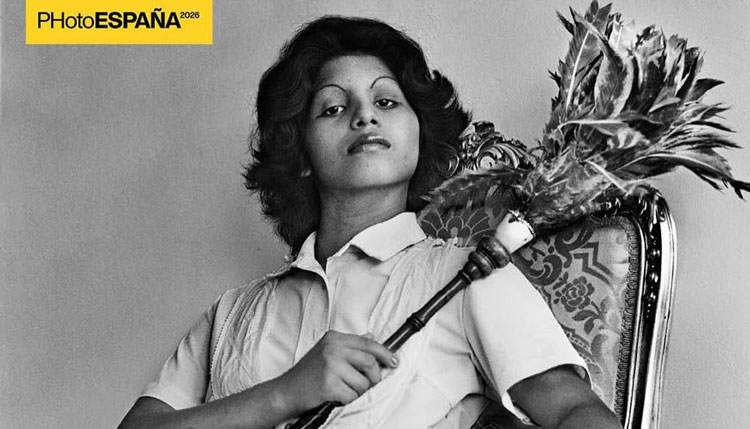
The Embassy of Panama in Spain and the MEMORIA art gallery inaugurate tomorrow Thursday at 6 PM at the MEMORIA Centro (Piamonte street, 19) The Servitude, an exhibition by the renowned Panamanian photographer Sandra Eleta, presented as part of PHotoESPAÑA 2026.
This exhibition, which will be open to the public until July 25, is an opportunity to discover one of the most emblematic photographic series of Panama, inviting reflection on identity, work, and collective memory.
The servitude constructs a visual essay in which the colonial trace runs through both bodies and spaces. Through portraits of domestic workers across two generations, Eleta subverts the inherited colonial and class gaze, revealing its persistence on both sides of the Atlantic.
In this series, the domestic imaginary – historically constructed as a space of subordination – becomes a field of tension in which hierarchies of gender, class, and coloniality operate. The frontal compositions, their formal restraint, the gestures, and the intensity of the gazes erode that logic: far from fixing subaltern identities, the women portrayed assert their presence and shift the axis of power within representation.
The ambiguity of the location is key: it is difficult to know whether the images were taken in Panama or in Spain. This underscores the continuity of a single visual and social regime, making visible how domestic imaginaries and class structures – deeply shaped by colonial history – are reproduced across both contexts.
Eleta understands photography as a space of encounter and negotiation. Her subjects are not passive figures but agents who maintain the gaze and articulate forms of silent resistance. The generational difference introduces a revealing nuance: where older women convey restraint, younger ones confront the camera, questioning their social place.
Eleta understands photography as a space of encounter and negotiation. Her subjects are not passive figures but agents who maintain the gaze and articulate forms of silent resistance. The generational difference introduces a revealing nuance: where older women convey restraint, younger ones confront the camera, questioning their social place.
The series culminates in the image of Romy during the U.S. invasion of Panama in 1989: the domestic worker appears armed, under the painted gaze of her employer’s portrait. The scene distills the political complexity of the project, turning the domestic space into a place of symbolic confrontation where power structures become legible.