


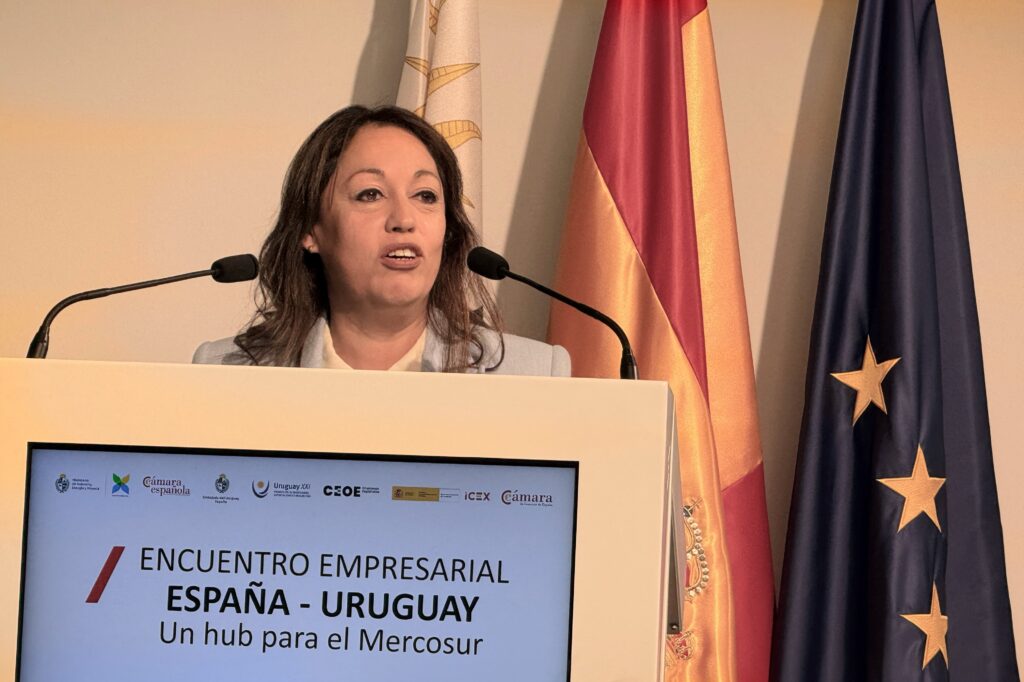
Uruguay offers political, economic, and legal certainties that confirm it as the perfect destination for investments for foreign companies, said the Minister of Industry, Energy and Mining of this country, Fernanda Cardona, yesterday at the Chamber of Commerce of Spain. And not only that: Uruguay wants to be the entry ‘hub’ to Mercosur.
During the Spain-Uruguay business meeting, attended by numerous entrepreneurs and representatives from both countries, the minister emphasized her Government’s objectives to achieve full decarbonization.
Cardona has already held several meetings with officials from the Ministry of Ecological Transition, including with the minister Sara Aagesen during this trip, with whom she has found a good rapport to promote cooperation in the research and development of alternative energies, such as synthetic fuels, electromobility, and energy storage.
She also stated that space policy is another of the objectives that Uruguay wants to develop with Spain. And she announced that her Government already has the Space Policy Bill project well advanced, which should serve as a framework for this objective, within the wide range of opportunities presented by the Uruguayan delegation.
The manager of Investment Promotion of Uruguay XXI, Alejandro Ferrari, gave a detailed presentation of the strengths and needs of the Uruguayan economy. Among the strengths, he mentioned monetary stability, exchange rate freedom, the qualification of the workforce, and its geographical position, which make this country the best platform for access to Mercosur.
All of this adds to the fact that the country is the most politically stable in all of Latin America and a reliable partner, with legal norms that guarantee foreign investments.
Among its needs and challenges, the Uruguayan delegation identified its interest in having Spain involved in the development of new infrastructures, in addition to the energy sector, in which they are already approaching a balanced and efficient supply of clean and renewable energies.
For all these reasons, the president of the Chamber of Commerce of Spain, José Luis Bonet, did not hesitate to emphasize that “Mercosur must be a lever that also serves to incorporate SMEs” at “a favorable moment, after the signing of the agreement,” as recalled by the executive deputy director of Uruguay XXI, Martín Mercado.
For his part, the first vice president of CEOE, Miguel Garrido de la Cierva, defended the importance of public-private collaboration when it comes to supporting the internationalization of companies and identified the establishment of a long-term investment climate as one of Uruguay’s strengths.
The minister counselor of the Embassy of Uruguay, Alison Graña, referred to the “mature relationship” of trust between both countries that allows Spanish companies to be the largest investors in the country, “with more than 7 billion dollars,” as pointed out by the deputy general director of America of the Secretary of State for Trade, Isabel Rata.
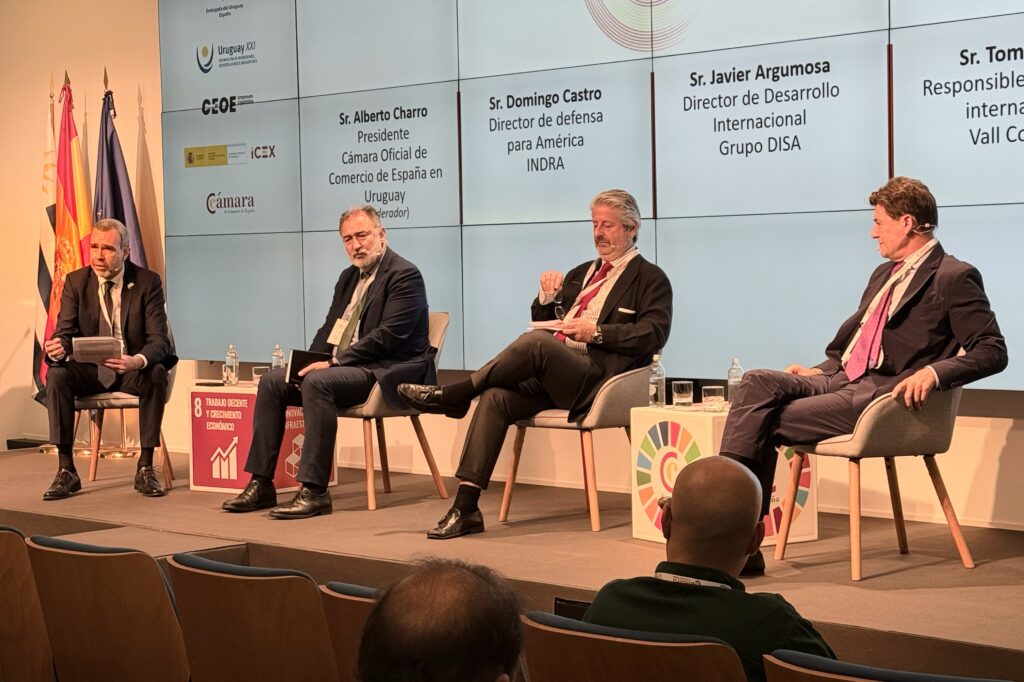
The meeting concluded with a round table —moderated by the president of the Official Chamber of Commerce of Spain in Uruguay, Alberto Charro— in which executives from three companies with investments in Uruguay —Tomás Blasco, head of international projects at Vall Companys; Javier de Argumosa, director of International Development of Grupo DISA; and Domingo Castro, director of Defense for America at INDRA— shared their experiences of their respective companies settling in the country.