


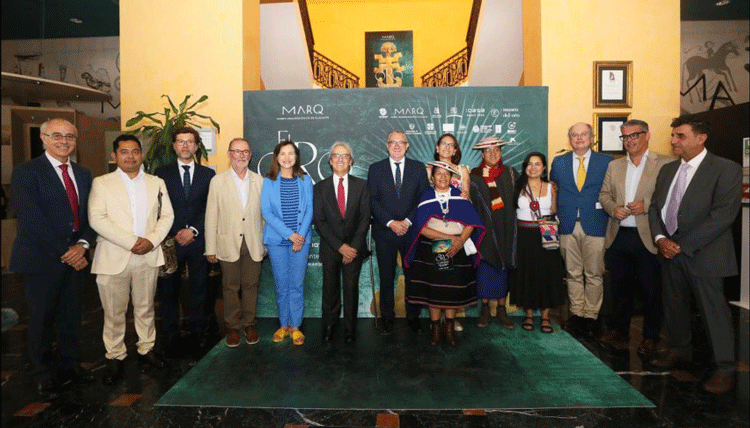
The exhibition The Gold and the Universe. Indigenous Knowledge of Colombia has been inaugurated at the Archaeological Museum of Alicante (MARQ) with the presence of the Colombian ambassador, Eduardo Ávila Navarrete, and the president of the Alicante Provincial Council, Toni Pérez.
The exhibition, which was presented on May 27 at Casa América in Madrid, unveils the enigmas of these communities, from their rituals, utensils, dances, and offerings to their connections with the universe or exchanges with the spirit world.
Nearly 300 pieces, many of them made of gold, make up this exhibition that will be open until May 2, 2027. It is the largest loan from the Gold Museum of Bogotá to a Spanish museum in years, featuring elements that are exhibited for the first time in our country.
The Colombian ambassador expressed his pride in presenting this “great exhibition and this great opportunity for collaboration that transcends the exhibition space and allows for a deeper understanding of indigenous knowledge, nature, the universe, humanity, and ways of understanding existence.” After indicating that culture “is one of the strongest bridges in society to establish lasting bonds,” Eduardo Ávila concluded that this is “an enriching experience that awakens curiosity, reflection, and admiration.”
In addition to the aforementioned authorities, the inauguration was attended by the director of the Gold Museum of the Bank of the Republic of Colombia, Alberto Escovar Wilson-White; the director of the MARQ, Manuel Olcina; the curator of the exhibition, Marcos Martinón-Torres, professor of Archaeological Sciences at the University of Cambridge; the managing director of the CV Marq Foundation, José Alberto Cortés, and the curator Marcela García Sierra.
The exhibition includes 291 archaeological objects, among them 157 made of gold, as well as creations from current indigenous communities, specifically selected for the occasion. Among the exhibition highlights are masks, earrings, and breastplates, hybrid beings such as the recognized human-bat or shamans in flight. These objects are unique and exceptional for their design and technical mastery, but also for the important role they played in ensuring the preservation of the world.
Equally relevant are the creations in ceramics and stone, among which stands out a wide diversity of figures of plants and animals, some of which are today threatened by the destruction of their ecosystems.
Toni Pérez, who has invited the people of Alicante, visitors, and the Colombian community in the province to visit this exhibition, pointed out that this proposal “represents a gateway for elements and knowledge of incalculable value that enter Europe and Spain through Alicante.” He also stated that this is an “impactful and unique exhibition as it reveals the natural, material, and spiritual wealth of the indigenous peoples of the past and present of Colombia through the collections of the Gold Museum of Bogotá.”
The setting and content of the exhibition create an immersive space that evokes various environments and concepts of the indigenous world through musical, architectural, museographic elements, videos, sounds, and smells based on recent research. Visitors can enter an indigenous maloca (sacred communal house), feel the fire in a metallurgical workshop, experience transitioning to other dimensions, or participate in ritual dances.
The sound environment includes melodies recorded with flutes and ocarinas between 600 and 1,000 years old, in dialogue with nature. There are also recordings of the soundscapes of the Andean páramo and the lowlands of the Caribbean, collected during field research, as well as a modern musical piece with Colombian roots and European echoes, composed especially for this exhibition. The smells in the room also offer an accessibility resource that, tailored to its content, individualizes its journey.
The guiding thread of this exhibition is based on the indigenous conception of a universe shared by human and non-human beings. What is exhibited at the MARQ is not adornments or jewelry, but living presences capable of acting in a world where there are no kings or treasures. The message is that gold is not accumulated, nor does it confer wealth; gold is given, shared, returned, and unites people instead of separating them.
Beyond their beauty and technical complexity, these extraordinary beings evoke millennia-old knowledge about transformation, balance, and reciprocity. Combining archaeology and anthropology, but also biology, engineering, science, and sustainability, this exhibition will transport visitors to a reality that offers keys to reflect on how to be in the world.