


Until the next December 30, and on the occasion of the commemoration of the 250th anniversary of the founding of the United States of America, the Real Academia de Bellas Artes de San Fernando joins the initiative promoted by the Embassy of the United States to highlight the American influence present in cultural and historical institutions in Madrid.
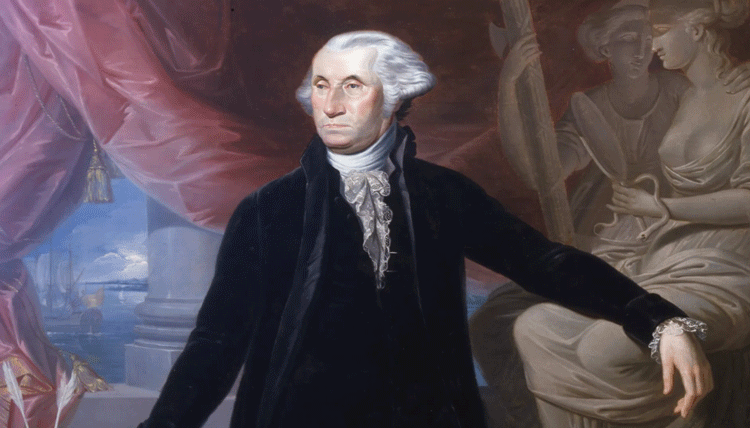
In Room 14 of the Academy museum, on the first floor, one of the few portraits of George Washington outside the United States is preserved, created by Josef Perovani (1765-1835) in 1796.
The Spanish diplomat Josef de Jáudenes participated in the negotiation of the Treaty of San Lorenzo (1795), signed in El Escorial by Thomas Pinckney, extraordinary envoy of the American president, and Manuel Godoy, Secretary of State of Charles IV, who was then directing the policy of the Spanish monarchy. With this agreement, the borders between the United States and the Spanish territories in North America regarding navigation and trade were established. After the end of the diplomatic mission, Jáudenes wanted to gift Godoy a portrait of the American president executed by the most prestigious American painter of that time, Gilbert Stuart (1755-1828), who could not accept the commission. The diplomat then turned to the Italian painter Perovani, residing in Philadelphia, who accepted.
To create the overall composition and the figure of the president, he referred to the well-known “Lansdowne portrait,” which Stuart had created that same year and which is now in the Philadelphia Museum. However, to paint the head, Perovani was probably inspired by the bust portrait of 1795 made by Charles W. Peale, currently in the New York Historical Society.
The canvas, owned by Godoy, became part of the Academy’s collections in 1816 after the confiscation of his assets by Ferdinand VII. Alongside the painting of George Washington is the portrait of Manuel Godoy that he commissioned from Francisco de Goya (1746-1828) in 1801, and the Portrait of Charles IV as Prince of Asturias, by Mariano Salvador Maella (1739-1819).