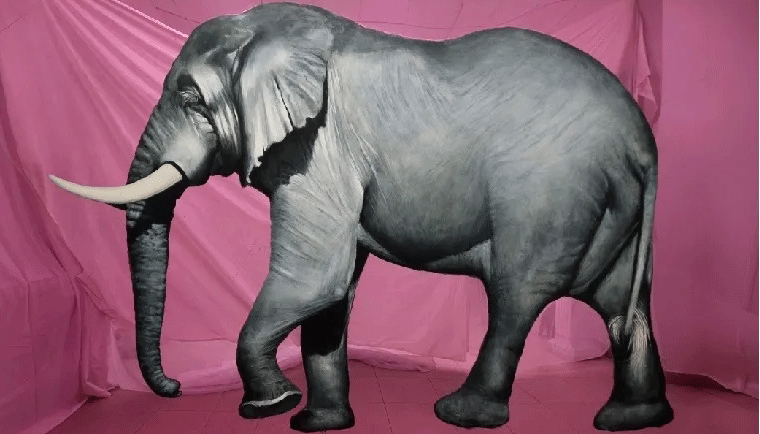
Until the next August 30, the contemporary art center CentroCentro in Madrid (Plaza de Cibeles, 1) presents the exhibition Albino, of all terrors, the terrible whiteness, by Isabel Gómez Liebre.
This exhibition develops from pictorial research around albinism taken as a territory of symbolic, political, and bodily tension. Far from understanding this mutation as a documentary or biological motive, the project approaches those bodies that culture has historically placed on the margins of representation: hyper-visible, ambiguous bodies, difficult to classify, traversed by fascination or fear.
In this sense, the project dialogues with some ideas of Michel Foucault about bodies considered anomalous and the cultural mechanisms that grant visibility, classification, and difference. The albino as a threshold between purity and threat, between the animal and the spectral.
Of all terrors, the terrible whiteness (Moby Dick, chapter 42, Herman Melville, 1851). This phrase introduces one of the central intuitions of the project: whiteness not as a symbol of purity but as an unsettling, excessive presence, almost impossible to capture. The white whale concentrates the most absolute terror linked precisely to that which overflows meaning and resists classification. This ambiguity also traverses Albino.
The piece presents the image of an albino elephant on a pale pink mirrored acrylic sheet measuring two by three meters. The support does not function solely as such, but as an essential part of the visual device. The reflective surface incorporates the body of the viewer into the work, forcing them to share the visibility space of the represented animal. The gaze then ceases to be external or innocent: the observer is also exposed. It also introduces an organic dimension. It is not an abstract or ideal whiteness, but a whiteness traversed by flesh, by physical vulnerability, by extreme sensitivity to light of a skin presented as an organ exposed to a non-neutral light, which becomes violent or sacrificial. The work thus proposes an experience of perceptual instability where image, reflection, and presence mutually contaminate each other. Albino does not seek to represent a fixed identity, but to open a space of inquiry about what culture illuminates, sets aside, or turns into anomaly. Where the skin becomes depth.
Isabel Gómez Liebre (Madrid, 1961) lives and works in Madrid. After her degree in Fine Arts (Complutense University of Madrid), she focuses on the direction and teaching of the art Atelier Estudio Isabel Gómez in Madrid, founded in 1999 and where she continues to work.