


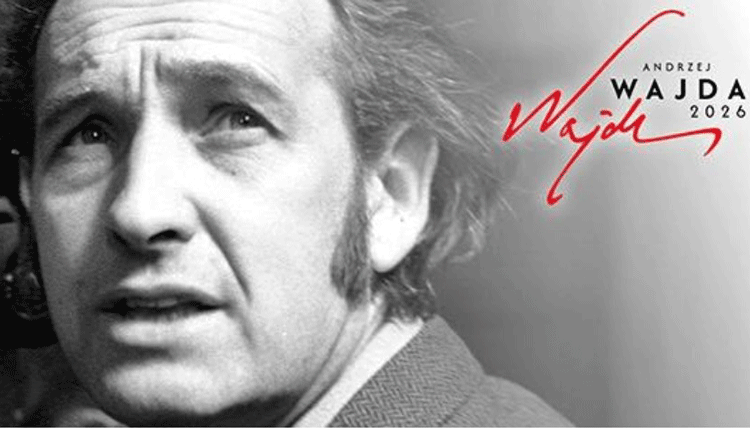
On the occasion of the centenary of the birth of director Andrzej Wajda, one of the great filmmakers of the 20th century, the Senate of the Republic of Poland has declared 2026 the Year of Andrzej Wajda.
And the Instituto Polaco de Cultura, together with the Documentary and Feature Film Studio (WFDiF), celebrates it in Madrid as it deserves: with a retrospective of 14 titles that traverses the extensive and essential filmography of one of the great masters of European cinema.
The cycle kicks off in Madrid from September 4 to 19 with fundamental pieces of his filmography, which will be screened at the Cine Doré-Filmoteca Española (calle de Santa Isabel 3), with titles such as Generation, Kanał, Ashes and Diamonds, Man of Marble, Man of Iron, or Katyn, among many others.
Wajda was much more than a director: he was the visual conscience of several generations of Poles, portraying like no one else the wounds of the Nazi occupation, the contradictions of communism, and the eternal pulse between the individual and History. This is complemented by his training at the Academy of Fine Arts, visible in every frame: a painter’s gaze that he never abandoned in his cinema.
The programming in Madrid brings together Generation (1955), his debut film, with which he inaugurated the so-called Polish School of cinema; Kanał (1957), awarded in Cannes, about the last fighters of the Warsaw Uprising taking refuge in the city’s sewers; and Ashes and Diamonds (1958), a portrait of a young political assassin in the final hours of World War II and one of the peaks of post-war European cinema: three works that delve into the sacrifice and moral reconstruction of a Poland just out of war.
Accompanying this retrospective are titles such as Everything for Sale (1969), an emotional tribute to actor Zbigniew Cybulski, who died prematurely and was a regular collaborator of Wajda; Landscape After the Battle (1970), inspired by the stories of Tadeusz Borowski about life in a displaced persons camp after liberation; The Wedding (1973), an adaptation of the famous work by Stanisław Wyspiański turned into an allegory about Polish identity and national myths; The Land of the Great Promise (1975), a fresco on industrial rise and wild capitalism in 19th century Łódź, based on the novel by Władysław Reymont; and Man of Marble (1977), one of the boldest cinematic critiques ever made against the propaganda of the communist regime, through the story of a worker turned socialist hero and the journalist who years later tries to reconstruct his true story.
Dates and times for a September with Andrzej Wajda at the Cine Doré:
Friday, September 4 / 20:00 hours / Room 1
Generation / Pokolenie (1955)
Wednesday, September 9 / 17:30 hours / Room 1
The Death Patrol / Kanał (1957)
Friday, September 11 / 20:00 hours / Room 1
Ashes and Diamonds / Popiół i diament (1958)
Sunday, September 13 / 17:30 hours / Room 1
Everything for Sale / Wszystko na sprzedaż (1969)
Tuesday, September 15 / 20:00 hours / Room 1
Landscape After the Battle / Krajobraz po bitwie (1970)
Saturday, September 19 / 19:00 hours / Room 2
The Land of the Great Promise / Ziemia obiecana (1975)
Sunday, September 20 / 17:30 hours / Room 1
Man of Marble / Człowiek z marmuru (1977)
Tuesday, September 22 / 17:30 hours / Room 1
Everything for Sale / Wszystko na sprzedaż (1969)
Tuesday, September 23 / 19:00 hours / Room 2
Generation / Pokolenie (1955)
Thursday, September 24 / 19:00 hours / Room 2
Landscape After the Battle / Krajobraz po bitwie (1970)
Friday, September 25 / 19:00 hours / Room 2
The Death Patrol / Kanał (1957)
Saturday, September 26 / 19:00 hours / Room 2
The Wedding / Wesele (1973)
Sunday, September 27 / 17:30 hours / Room 1
Ashes and Diamonds / Popiół i diament (1958)
Tuesday, September 29 / 17:30 hours / Room 1
The Land of the Great Promise / Ziemia obiecana (1975)