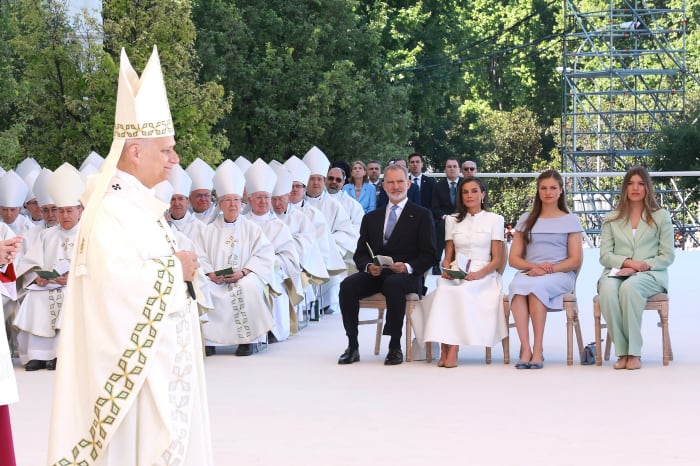
I have a neighbor who does not understand the importance of a pope, in this case Leo XIV, visiting a country. “Why? If he is not going to convert me,” he says, and walks away muttering something incomprehensible. I am left pondering. The reasoning has not many nuances. In fact, none. But, setting aside religious or economic considerations, I suppose it is not easy to understand the intricacies of Vatican diplomacy.
Many people do not quite process the diplomatic concept of ‘soft power’ — an apparent contradiction — and even less so if it is associated with the Catholic Church. For those who think this way, power is hard, it is strong. And in politics, strength is everything. At least that is what is in vogue. But it is not true. We see it day by day in the ongoing wars. Strength, no matter how overwhelming, does not guarantee victory.
The Vatican does not have large armies, its territory is tiny, it is not a nuclear power, it does not invest in cutting-edge weapons. It also does not impose economic sanctions, nor does it have a powerful industry, nor does it enter into bidding wars for rare earths. So what power does it have, if it cannot impose its military strength or its economic power?
The true power of the Vatican lies in its influence. To begin with, over 1.406 billion Catholics distributed around the world, accounting for almost 18% of the global population. Indirectly, its influence also extends to other branches of Christianity, which together group almost 1 billion more people, and to any human being, regardless of their beliefs, who can be convinced simply with a good dose of common sense.
It can be argued, and it is true, that the Roman Church has not always been an example. Fair enough, but let us acknowledge its value for all humanity when it can have it. And, as is the case, let us not assume that, for example, this pope will not be able to do anything to satisfy the victims of past abuses.
However, the Vatican cannot, nor should it, intervene in any electoral process, but it is undeniable that any opinion expressed by the Holy Father ends up being potentially ‘dangerous’ for a ‘populist’ politician because his followers will always be willing to follow the signals of their guide, in this case the pope. And that is also power.
To better understand the strength of Vatican diplomacy, let us see what happened in the year 2000 with AIDS medications. The Holy See managed to convince developed countries to allow part of the production to be sent to developing countries, which lack the resources to pay patents to powerful pharmaceutical companies. That is ‘soft power’.
Raising one’s voice for the most disadvantaged anywhere in the world, opposing arms proliferation, and supporting missionary action are not merely acts of charity but demonstrations of public diplomacy in times when we see how many governments are withdrawing their aid for the development of poorer countries.
Understanding that issues like these affect all human beings — whether they are Muslims, Jews, Buddhists, or staunch atheists — it is obvious that anyone who raises them in public receives, at least, a dose of approval even from those who are not their co-religionists nor share nationality, but who may perfectly share their argument.
And that, in a way, can help shape a transnational coalition of common sense that puts the human being at the center and halts the attempts of technoligarchs to control all the levers of society in pursuit of their economic objectives.
If Leo XIV is showcasing anything, it is common sense. He did not arrive at the Chair of St. Peter by chance, but because of what his colleagues in the Curia already knew about him as a dialogue-loving man who likes to listen to everyone, as he has already begun to demonstrate on this visit.
In a world where many leaders value strength and imposition over dialogue, it is hopeful to see that the pope of Rome may be capable of weaving goodwill agreements and pointing out the dangers of misused technology. Robert Prevost does not seem like a man who bites his tongue. And that sensible and calm, yet firm voice is what the world needs in times of turmoil. I say this as a convinced agnostic, which is what I am.