Pope Leo XIV faced one of the most significant days of his apostolic journey to Spain yesterday with a schedule concentrated in the Catalan capital. After concluding his stay in Madrid, the Pontiff moved to Barcelona to star in a series of events that combine pastoral, institutional, and popular dimensions, in a visit that has mobilized thousands of faithful and a wide security device.
The agenda of the Holy Father began with his transfer from Madrid to the Josep Tarradellas Barcelona-El Prat airport. Upon arrival, Leo XIV was received by the president of the Generalitat, Salvador Illa, the president of the Parliament, Josep Rull, the mayor of Barcelona, Jaume Collboni, and representatives of the Spanish Executive.
First stop: the Cathedral of Barcelona
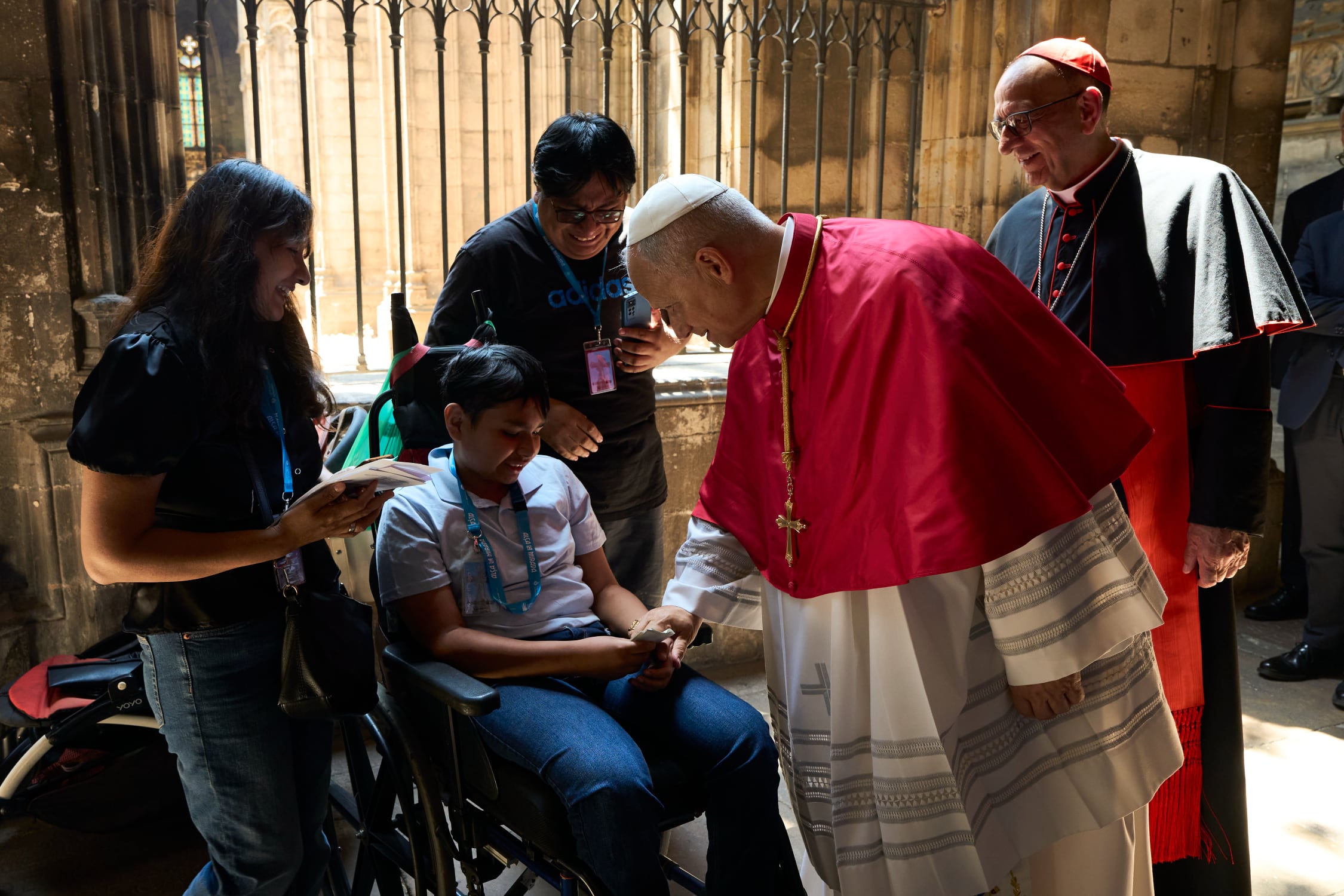
After leaving the airport, the Pontiff headed to the historical heart of the city. His first major appointment took place at the Cathedral of the Holy Cross and Saint Eulalia, where he was received by the Cardinal Archbishop of Barcelona, Joan Josep Omella, and performed the well-known prayer of the sixth hour. His first words in the Cathedral recalled the visit to the city by John Paul II in 1982, and how he recognized the city and its citizens as a wide and open place. Leo XIV spoke of building in harmony and communion beyond all polarization. His first words in Catalan were: “Dear friends, Barcelona, in this sense, has a great tradition of church” (“Dear friends, Barcelona, in this sense, has a great tradition of church”).
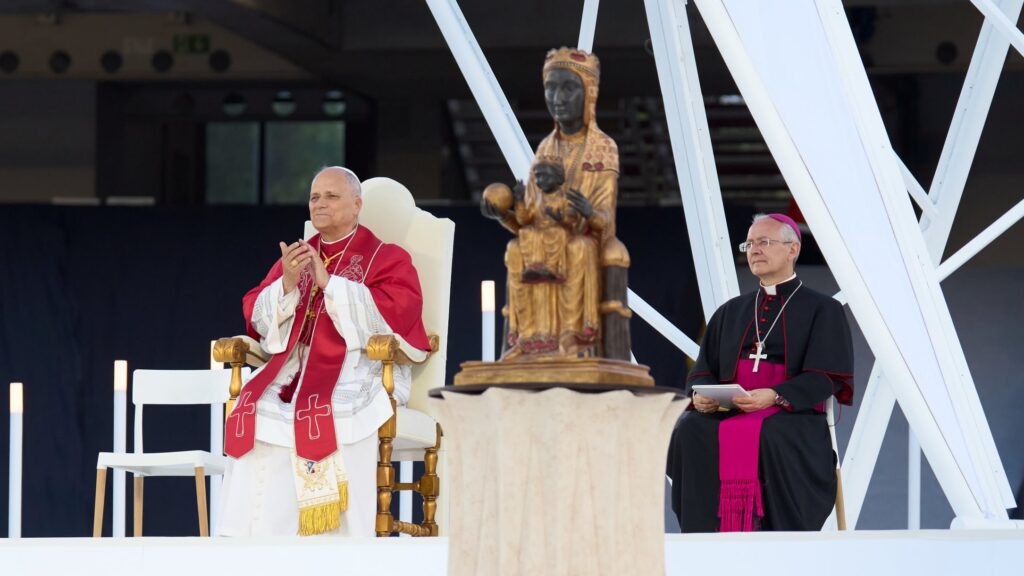
His homily had a pacifying and unifying character, directed both at the Christian community and the entire society: “In a world torn apart by wars and divisions, in an increasingly individualistic society, we want to be ‘martyrs’, that is, witnesses and prophets of unity, welcome, concord, and peace, even at the cost of sacrifices and renunciations. Barcelona is called ‘Cap i Casal de Catalunya‘. What gives this community, all of you, Barcelonians and Catalans, a special vocation and responsibility to become, with God’s help, builders of unity.”
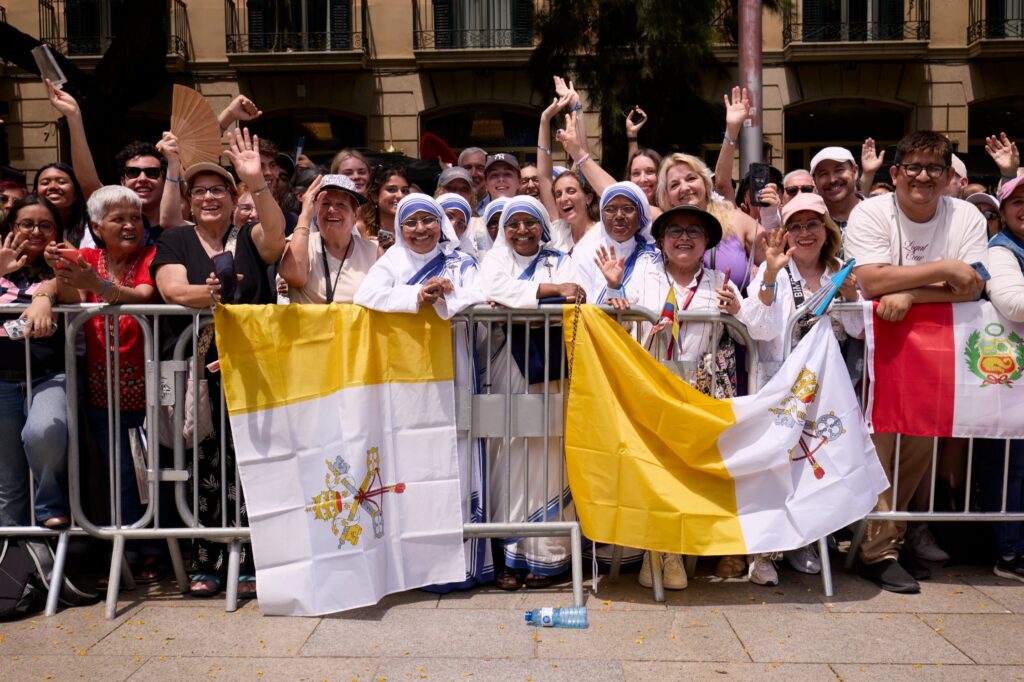
After the prayer and a moment of reflection in the chapel of Saint Eulalia, the pope addressed the faithful, who were waiting in a completely packed square of the Cathedral, with a “Good day and good hour” and thanked them for their patience during the long wait. After that, he withdrew with a “adeu-siau” (“goodbye”) towards the Episcopal Palace, always acclaimed by the crowd, to have lunch, rest, and hold private audiences, including members of the order of Augustinians and the president of the Generalitat of Catalonia, Salvador Illa. Sources from the Executive explained that they discussed topics such as the current international context and the Pope’s latest encyclical, which addresses the challenges of technological advances and their effects on humanity.
The great act of the day: massive vigil at the Olympic Stadium
The central event of this Tuesday took place at the Lluís Companys Olympic Stadium. There, a large prayer vigil was held with the participation of nearly 40,000 attendees, young people, families, and pilgrims from different parts of Spain and Europe: the most massive and festive event of his visit to the city.
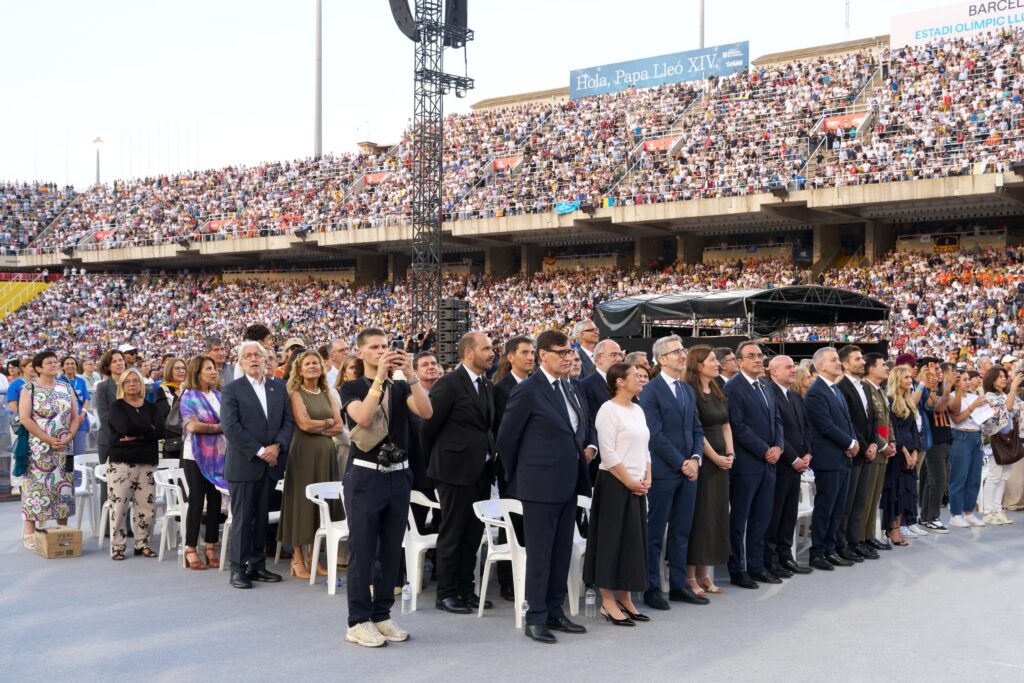
One of the main novelties of the event was the installation of 50 confessionals inside the Olympic Stadium. In this way, the Archdiocese of Barcelona has opted to integrate confessions within the venue itself, a different formula from that chosen in Madrid.
The vigil was structured in two distinct parts: one more playful and the other more solemn. After the opening of the doors, music was the protagonist with performances by artists such as Sabor de Gràcia, Alfred García, Beret, and Siloé, among others. Afterward, the Pope entered the stadium around 8:00 PM in the popemobile, touring the track to greet the attendees closely.
The Archbishop of Barcelona, Juan José Omella, welcomed Leo XIV in an event where the colla castellera of Vilafranca del Penedès raised a human tower, a symbol of effort and unity. During the meeting, Omella expressed: “We are very happy, this is the youth of the Pope. We are all young today with the Holy Father, who connects with us.”
The Pope led the vigil in a more participatory format than a traditional liturgical ceremony. During the meeting, there were moments for questions posed by young people on social and spiritual issues, readings from the Gospel, and various moments of shared prayer.
Especially moving were the three testimonies that allowed addressing crucial topics such as faith and forgiveness, touching on issues like mental health or violence against women.
First, Ferran, from the Parish of the Holy Family, asked how we can keep our gaze lifted towards what truly matters. The Pope responded in Catalan and Spanish: “Many young people and adults are rediscovering the Christian faith, it is a really important step.” He also added: “Our desire for truth and happiness needs a larger horizon.” In the same vein, the pontiff elaborated: “When people learn to pause, to value important things, to appreciate time in a new way, and to think about their own lives letting themselves be illuminated by the Gospel, they also develop critical thinking regarding a social system that does not place the person at the center and provokes situations of injustice and existential poverty at various levels.”
Later, Carmina, a young secondary school teacher, asked him about depression and explained, emotionally, that she herself had silently struggled against the illness for many years. The Pope highlighted the problem of mental health and the importance of dedicating resources to it, stating: “In contact with Jesus, even those who feel lost can rise.” The Holy Father emphasized that mental health must be a priority of the healthcare system and concluded: “In times of pain, we must open ourselves to someone who can help and accompany us. We must not spiritualize pain. God does not want suffering, let us remember what Pope Francis said: with God, life always reborn.”
The third testimony was Desiré, a 20-year-old law student, who explained her harsh family history, marked by her father’s attempted murder of her mother, and asked about forgiveness. The Pope replied: “Forgiveness is a sign of God’s grace. Violence against women is a dramatic reality. We are called to address it, whether personally or as a society. We cannot attribute to God what has been entrusted to our personality. If violence exists, we must ask ourselves questions and not God.”
Subsequently, the Pope delivered the homily during the prayer vigil, highlighting that “we are called to dialogue with the shadows of our human condition”. In his address, the pontiff urged those present to maintain a constant attitude of reflection: “Let us not stop asking ourselves, seeking, dialoguing, with God and with ourselves”. He also defended the need to build “a society where each person is respected in their dignity and loved for who they are”.
With the blessing, the liturgical part ended, and it would be time for the singing of the Virolai by the Montserrat Choir, and the performance of Sergio Dalma.
A day of transition towards the great day at the Sagrada Familia
Although the activity on Tuesday concentrated great expectation, Leo XIV’s visit to Barcelona will reach its climax today with the events planned at the Basilica of the Sagrada Familia, where the Pontiff will participate in the inauguration of the Tower of Jesus Christ and preside over one of the most massive celebrations of his entire journey to Spain.
However, the day of this Tuesday has left a powerful image: that of a Pope arriving in Catalonia amidst a strong popular welcome and with the intention of placing at the center of his message issues such as fraternity, welcome, and the role of the Church in contemporary society.