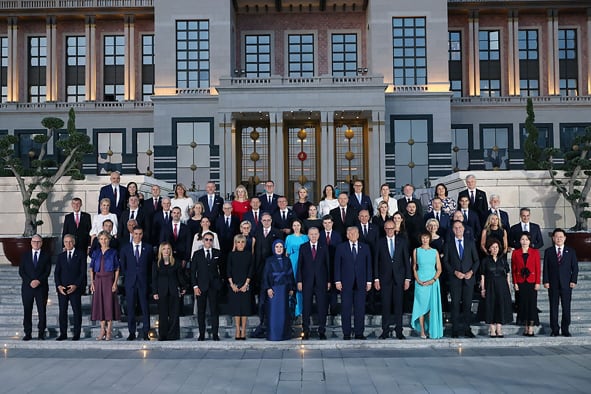
Donald Trump had not forgotten about Greenland. The President of the United States struck again on Tuesday, just as the NATO summit in Ankara began. “Greenland should be controlled by the US and not by Denmark,” he said a few minutes before meeting with his friend, Turkish President Recep Tayyip Erdogan, and the gala dinner with which the host wanted to welcome his guests.
Is it possible that a vast expanse of ice, historically isolated and remote, could become one of Trump’s ‘casus belli’ against his European allies and the epicenter of 21st-century global geopolitics? What was once a frigid desert guarded by the silence of glaciers is today the board where great powers —the United States, China, and Russia— move their pieces with unprecedented urgency. Greenland is no longer just the largest island in the world; it is the key to a melting Arctic that promises to alter global trade, military security, and the supply of critical minerals for the technological future.
An old longing of the stars and stripes
For many, the idea of buying Greenland put forward by Donald Trump months ago sounded like a boutade, but it is worth remembering that in 2019 he made a similar purchase offer that at the time was taken as an eccentricity or an anachronism of the 19th century. However, for Washington, the interest in the island is not a media occurrence, but a historical constant dictated by geography. The control of Greenland has been a fundamental piece in the U.S. security doctrine for over a century.
As early as 1867, the same year the U.S. bought Alaska from Russia, the State Department explored the possibility of acquiring Greenland due to its strategic importance and fishing resources. However, the critical moment came with World War II. After the occupation of Denmark by Nazi Germany in 1940, the United States took on the protection of the island to prevent it from becoming a Luftwaffe base from which to attack the American east coast.
At the end of the conflict, in 1946, President Harry S. Truman offered Denmark 100 million dollars in gold for the island. Although Copenhagen rejected the offer, the Cold War solidified the U.S. military presence through the construction of Thule Air Base (now Pituffik Space Base). Located halfway between Washington and Moscow, Greenland allowed the deployment of essential early warning radars to detect intercontinental ballistic missiles. The island has never left the Pentagon’s radar; simply, the focus of the threat has changed names.
Maritime routes and rare earths
Climate change is transforming Greenland into a territory of unprecedented economic opportunities. The retreat of the ice sheet, although bad news regarding climate change, is opening “windows” of navigation that were previously unimaginable. The melting of the Arctic promises to enable new trade routes that could reduce transport time by up to 40% compared to the Suez Canal, positioning Greenland as a mandatory logistical base in the heart of the new maritime highways.
On the other hand, the island has great potential for rare earths and other critical minerals essential for the manufacture of electric vehicles, wind turbines, and smartphones. This would break China’s monopoly on rare earths, a factor that explains why Beijing has tried to finance port and airport infrastructure on the island, raising alarms in Washington.
The new geopolitical board
The geostrategic value of Greenland today transcends its physical location; it has become a symbol of competition among great powers. Russia has reactivated Soviet-era military bases in the Arctic, militarizing the region at a pace that worries NATO. China, for its part, seeks in Greenland a base for its polar ambitions.
In this scenario, the United States has reacted with hyperactive diplomacy. The reopening of its consulate in the capital, Nuuk, in 2020 and direct economic aid packages are clear signs that Washington will not allow other powers to fill the influence vacuum in its northern “backyard.” Greenland is today what the Persian Gulf was in the 20th century: the place where it is decided who will control the resources and routes of tomorrow.
And what do the 56,000 inhabitants of the island think about this? For the population, mostly of Inuit origin, this renewed international interest represents a double-edged sword. On one hand, foreign investment offers a path towards total economic independence from Denmark. On the other, the risk of becoming a sacrificial pawn in the game of thrones between Washington and Beijing is real. Greenland, the island of ice, is hotter than ever, not only because of climate change but fundamentally due to a geopolitics that is once again looking north to define the fate of the world.
The Prime Minister of Denmark, Mette Frederiksen, immediately responded to Trump. And she did so without ambiguity: “It is well known that the United States intends to appropriate Greenland. I hope it is equally known everywhere that this is not going to happen,” she said in a tone that does not bode well for a great understanding with Trump in Ankara, despite the efforts of the North American leader’s personal sherpa at NATO, Secretary General Mark Rutte.
Meanwhile, Ankara has become a continuous hotbed of rumors about all kinds of European initiatives to replace the capabilities that the United States has so far provided, from Greenland to Central Europe.