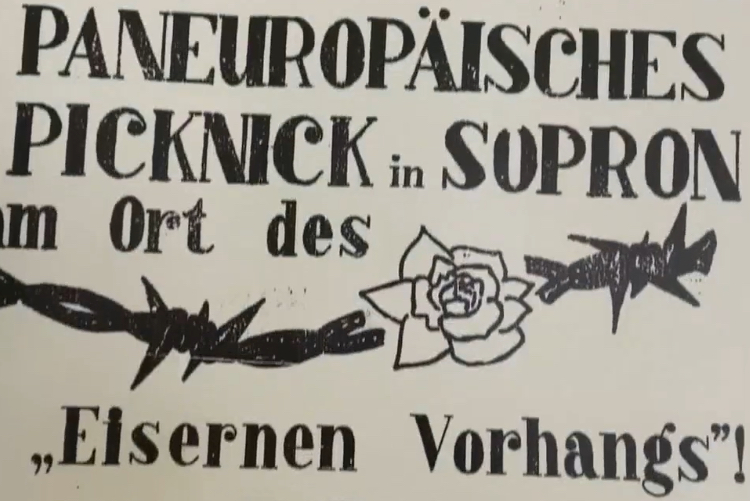
On August 19, 1989, in a corner of the border between Hungary and Austria, an apparently modest event took place that would end up acquiring enormous historical significance. Under the name of Pan-European Picnic, hundreds of people gathered to symbolically celebrate European unity. But that peaceful meeting ended up becoming one of the decisive episodes of the end of the Cold War: several hundred citizens of the German Democratic Republic (GDR) took advantage of a temporary opening of the border to escape to the West.
Thirty-seven years later, the Pan-European Picnic can be remembered not only as an episode that contributed to the fall of the Iron Curtain, but also as a warning about the value of open borders, freedom, and European cooperation.
To understand what happened in Sopron, one must situate oneself in Europe in 1989. The continent had been divided for more than four decades by the Cold War. To the east were the communist states linked to the Soviet Union; to the west, the liberal democracies progressively integrated into European and Atlantic structures.
However, during the second half of the 1980s, the Soviet system began to show evident signs of exhaustion. The reforms driven by Mikhail Gorbachev —perestroika and glasnost— reduced Moscow’s ability to impose discipline by force on its Eastern European allies.
Hungary was one of the countries that most quickly took advantage of this new situation. On May 2, 1989, it began to physically dismantle the border barrier with Austria. Although the border was still controlled, the removal of the barbed wire had enormous symbolic value: for the first time, one of the most guarded borders in Europe was beginning to disappear.
The situation took on an even greater dimension during the summer. Thousands of citizens from East Germany had traveled to Hungary as tourists, but many decided not to return to the GDR. Their goal was to reach Austria and, from there, the Federal Republic of Germany.
In this context, the idea of organizing a peaceful meeting at the border emerged. What was initially intended to be a celebration of European reconciliation ended up becoming an unexpected opportunity for those seeking freedom.
The protagonists
Among the main protagonists were Otto von Habsburg, president of the Pan-European Union and member of the European Parliament, and Imre Pozsgay, a prominent Hungarian reformist politician and member of the Government. Ultimately, Otto von Habsburg was represented that day by his daughter Walburga Habsburg Douglas, who is currently the vice president of the Pan-European Union.
The initiative also involved the participation of sectors of the Hungarian democratic opposition, particularly linked to the Hungarian Democratic Forum (MDF). The idea had emerged in opposition circles and took shape during the summer of 1989.
But there were other less-known protagonists who were probably just as important as the politicians: the citizens of East Germany themselves. For them, the Hungarian-Austrian border represented a concrete possibility of escaping from a regime that severely restricted freedom of movement.
The Hungarian border guards also played a fundamental role. Their decision not to use weapons against the fugitives would be decisive. At that moment, they did not receive clear instructions on how to act in such an extraordinary situation and, ultimately, allowed the citizens of the GDR to cross the border.
The events
The Picnic took place on August 19, 1989, near Sopron. A symbolic and temporary opening of a border crossing was planned for a few hours, between three and six in the afternoon. The official objective was to allow a peaceful meeting between Hungarians and Austrians.
But the news had reached the citizens of East Germany who were in Hungary. Even before the official start of the program, groups of refugees began to gather at the border.
Suddenly, several hundred people ran towards the border crossing. The Hungarian guards did not fire. The barrier was crossed and the citizens of the GDR reached Austria.
In a matter of minutes, a symbolic celebration of European unity had transformed into a massive escape to the West.
Almost 600 citizens of East Germany managed to escape that day. The European Union currently considers that episode one of the events that marked the beginning of the destruction of the Iron Curtain.
The effect was immediate. The news demonstrated that the border could be crossed and that the Hungarian authorities were willing to act differently from other communist governments.
On September 11, Hungary officially opened its border to citizens of East Germany who wanted to head west. Thousands took advantage of the opportunity.
Two months later, on November 9, 1989, the Berlin Wall fell.
Consequences: from the Picnic to present-day Europe
It would be an exaggeration to claim that the Pan-European Picnic alone caused the fall of the Berlin Wall. The disappearance of European communism was the result of numerous political, economic, and social factors. However, the episode in Sopron had enormous symbolic and practical value.
The opening of that small border gate showed that the European division system could begin to crack in an unexpected place. The chain of events that followed led to the fall of the Wall, German reunification, the disappearance of the communist regimes in Eastern Europe, and, ultimately, the expansion of the European Union to the center and east of the continent.
The significance of the Picnic is especially interesting when viewed from Europe in 2026. Today, many Europeans can cross the internal borders of the European Union without controls, study in another country, work there, or establish their residence. For a generation born after 1989, that freedom may seem completely normal.
But the Picnic reminds us that it was not always so.
The image of hundreds of East Germans running towards Austria possesses a power that transcends the history of the Cold War. Those people were not simply crossing a border: they were trying to regain the freedom to decide where to live, travel, and build their future.
And precisely for that reason, the anniversary of the Pan-European Picnic remains relevant. Europe is once again facing wars, geopolitical rivalries, disputed borders, and debates about security and sovereignty. The Russian invasion of Ukraine has shown that peace and European cooperation cannot be taken for granted.
The memory of 1989 does not mean that all borders should disappear or that Europe can do without security. It means something deeper: that borders must serve people and coexistence, and not become instruments of oppression.
The Pan-European Picnic began as a small celebration next to a barbed wire fence. It ended up becoming one of the symbols of European freedom. Its true importance lies not only in the hundreds of people who crossed that border on August 19, 1989, but in what that scene anticipated: a Europe that could be united again.
In 1989, a few meters of border were enough to demonstrate that the Iron Curtain was not eternal. Today, remembering that day also means remembering that freedom, democracy, and European unity are historical achievements that need to be preserved.