Diplomacy News
es Español en English
14 de Aug, 2026
No Result
View All Result
  • Current Affairs
    • Business
    • Diplomacy
    • Geopolitics
  • In Depth
    • Interviews
    • Reports
    • Research
  • Life
    • Culture
    • Gastronomy
    • Tourism
  • Opinion
  • Agenda
  • Who is Who
  • DiplomacynewsTV
NEWSLETTER
Diplomacy News
NEWSLETTER
Diplomacy News
No Result
View All Result

Conference at Casa América on the architecture of the city of Arequipa

Juan David Latorre by Juan David Latorre
15 de April de 2026
in Culture, Life
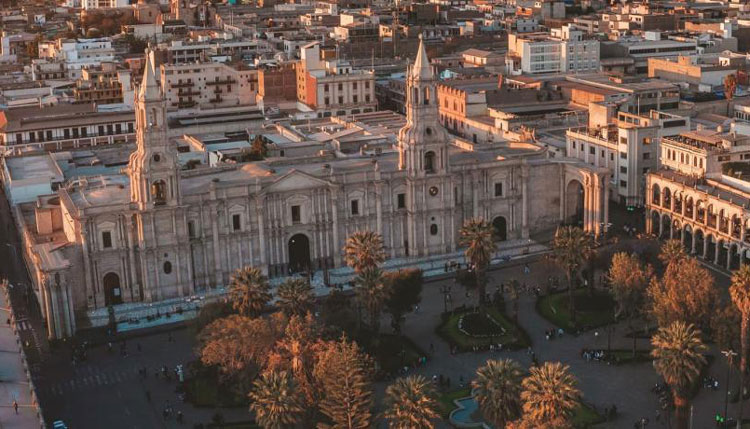
La ciudad de Arequipa.

La ciudad de Arequipa.

Arequipa, founded in 1540 in southern Peru, constitutes an exceptional case of synthesis and mestizaje reflected in both its architecture and urban configuration.

As part of the cycle History and Ibero-American Heritage Cities, next Tuesday at 6 PM in its Simón Bolívar Hall, Casa América presents the conference Arequipa: the persistence of mass and the aesthetics of dispossession as a synthesis of the Ibero-American city.

The presentation will be given by Gonzalo Ríos, an expert in Arequipeña architecture and a principal professor at the Universidad Católica de Santa María. Start

Arequipa, founded in 1540 in southern Peru, constitutes an exceptional case of synthesis and mestizaje reflected in both its architecture and urban configuration. Located in a geography of tensions between volcanoes, desert, and inter-Andean valleys, the city gained relevance during the Viceroyalty of Peru as a confluence of commercial and cultural routes. In this scenario, an exceptional local workforce adapted construction knowledge to the telluric conditions, infusing that same strength into its cultural configuration.

Without the initial political relevance of Cusco or Lima, Arequipa gained prominence from its strategic location and a thorough understanding of its resources. Its population developed very early an identity linked to territorial values and a relative autonomy from external influences. Inserted in a rigid grid of Renaissance influence, its architecture is the result of the persistence of builders who learned to strip away the superfluous to create massive forms capable of withstanding recurrent seismic activity. Thus, the city shapes its physiognomy through intense reconstruction processes, improving its structures and incorporating new stylistic repertoires into an almost unalterable stereotomic matrix.

During the period of American Baroque, Arequipa consolidated itself as one of the main centers of architectural production with a direct radiation over a good part of the Andean south. This process should not be understood solely by its stylistic epidermis, but by a particular way of occupying spaces and inhabiting the territory. Already in the republican era, this scenario of ethnic mestizaje positioned it as a bastion of revolutions and the cradle of decisive thinkers for the political and cultural configuration of Peru, such as the Nobel Prize-winning author Mario Vargas Llosa.

Given this compelling way of conceiving architecture from identity and persistence, Arequipa is today a paradigm of the harmonious fusion between the Hispanic and the indigenous. Its churches and mansions remain as inspiring models for the contemporary practice of its own architecture. After its declaration as a Cultural Heritage of Humanity by UNESCO in the year 2000, the city today faces the challenge of managing the benefits and dangers of mass tourism and gentrification, reaffirming itself as one of the essential references of Ibero-American urbanism and architecture.

After the welcoming words from Moisés Morera, director of Programming at Casa de América, Gonzalo Ríos, an expert in Arequipeña architecture and a principal professor at the Universidad Católica de Santa María in Arequipa, and Alonso Ruiz Rosas, cultural advisor of the Embassy of Peru, will participate. Free entry until full capacity is reached.  
Tags: Casa AméricaPerú
Juan David Latorre

Juan David Latorre

Born in Madrid in 1961, graduated in Information Sciences at the Complutense University, he directed his first steps to the graphic arts and publishing sector. Finally, he stood out in the diplomatic world, loving culture and convinced that through it all countries can be united. jdlatorre@diplomacynews.com

Related Posts

A cruise ship in Malaga./ Photo: Aitormmfoto / iStock
Diplomacy

Diplomacy on the High Seas: Cruises as Stages of International Relations

by Rosa Ausió
14 de August de 2026

Cruise activity requires ongoing coordination between states, international organizations, port authorities, and shipping companies

Read moreDetails
Spanish contemporary art in European embassies with ‘la Caixa’ Foundation

Spanish contemporary art in European embassies with ‘la Caixa’ Foundation

13 de August de 2026
Exhibition 'Let the Meat Bloom - Abya Yala', by Rosmery Lara Quartz

Exhibition ‘May the Flesh Blossom – Abya Yala’, by the Honduran Rosmery Lara Quartz

13 de August de 2026
A thermometer in a street in Seville./ Photo: Carlos Koblischek / iStock

The loyalty of international tourists to Spain is wavering due to extreme heat

10 de August de 2026
Spectacular entrance to the Astana Planetarium. / Photo: AR

Tourism in Kazakhstan: the Great Steppe, alpine landscapes and the cities of the future

10 de August de 2026

Lo más leído de esta semana

  • Dancing House of Prague. /Photo: IStockphoto. Vladislav Zolotov

    The Dancing House of Prague celebrates its 30th anniversary as a Czech emblem

    158 shares
    Share 63 Tweet 40
  • Diplomacy on the High Seas: Cruises as Stages of International Relations

    158 shares
    Share 63 Tweet 40
  • August 15: The living civilizational ties between India and Southeast Asia

    157 shares
    Share 63 Tweet 39
  • Colombia’s earthquake: Ministry confirms one deceased and 12 missing spaniards

    153 shares
    Share 61 Tweet 38
  • Spain invests 125,440 euros in the FAO Blue Ports Initiative

    153 shares
    Share 61 Tweet 38

Newsletter Diplomacy News

NEWSLETTER

Lo último en Diplomacy News

Prime Minister Shri Narendra Modi, together with Prabowo Subianto, the president of Indonesia, visited the Temple Complex of Prambanan, a UNESCO World Heritage site, in Yogyakarta (Indonesia). /Photo: Courtesy of the Embassy of India

August 15: The living civilizational ties between India and Southeast Asia

14 de August de 2026
A cruise ship in Malaga./ Photo: Aitormmfoto / iStock

Diplomacy on the High Seas: Cruises as Stages of International Relations

14 de August de 2026

Sections

  • Business
  • Culture
  • Current Affairs
  • Diplomacy
  • DiplomacynewsTV
  • Gastronomy
  • Geopolitics
  • In Depth
  • Interviews
  • Life
  • Opinion
  • Reports
  • Research
  • Tourism

About Diplomacy News

  • Nosotros
  • Aviso Legal
  • Política de Privacidad
  • Política de Cookies
  • Contactar
logo diplomacy news

© 2026 Diplomacy News.

No Result
View All Result
  • Current Affairs
    • Business
    • Diplomacy
    • Geopolitics
  • In Depth
    • Interviews
    • Reports
    • Research
  • Life
    • Culture
    • Gastronomy
    • Tourism
  • Opinion
  • Agenda
  • Who is Who
  • DiplomacynewsTV
  • Español

© 2026 Diplomacy News.