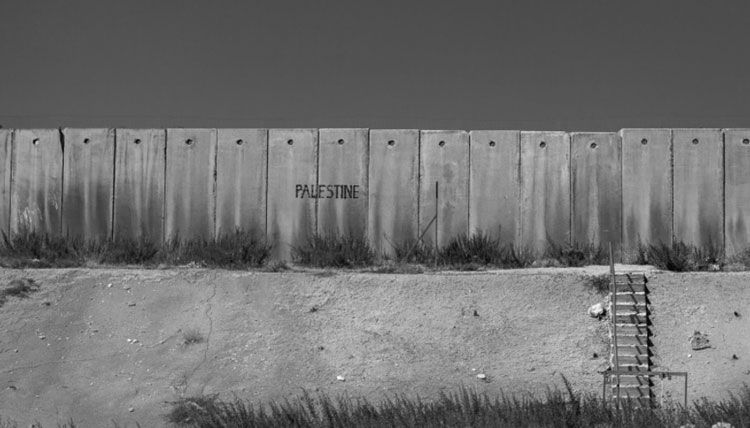
From June 12 to October 18, Casa Árabe in Madrid presents the exhibition Driving through Palestine, by multidisciplinary artist and academic Rehab Nazzal.
For most Palestinians, freedom of movement is severely restricted. Traveling through their own territory involves crossing checkpoints, barriers, and multiple forms of surveillance. In this context, movement becomes not only a daily experience of occupation but also an act of resistance.
Between 2010 and 2026, Rehab Nazzal undertook the risky task of traveling, driving, through all of occupied Palestine. The result is an extensive photographic and audiovisual project that documents, with rigor and urgency, landscapes, sounds, and realities rarely visible outside the territory.
Curated by Stefan St-Laurent, Driving through Palestine maps contemporary Palestine through Nazzal’s perspective. The roads she travels are marked by signs and warnings that evidence the conditions imposed by the occupation. Thanks to the artist’s perseverance, a singular work emerges that reveals a fragmented geography and offers an essential testimony of life under Israeli military control.
The exhibition is the result of the collaboration between Casa Árabe and the Canada Council for the Arts, the Saw Centre gallery in Ottawa, and the Embassy of Canada in Madrid. Its inauguration is part of the program of the annual conference of the International Association for Middle Eastern Studies, founded in 1967 (IAMES, for its acronym in English), which has been sponsored by the University of Calgary.
Rehab Nazzal is a Palestinian-Canadian artist, researcher, and academic whose interdisciplinary practice encompasses photography, video, installation, and sound art. Her work examines the consequences of military occupation, settler colonialism, environmental violence, and control policies over bodies and territories. Through documentary methodologies and long-term research, Nazzal explores the daily experiences of Palestinian communities under occupation, as well as the relationships between memory, landscape, and resistance. Her work has been exhibited internationally and is part of a sustained commitment to social justice, human rights, and the production of knowledge from critical and decolonial perspectives.